Traditional search engine optimization isn’t enough to keep your business visible in today’s digital world. Host Juliet Clark welcomes AI visibility strategist Amy Yamada to discuss how authority level experts can adapt to generative engine optimization. Web traffic is shifting as potential clients ask large language models for direct recommendations rather than searching Google. Amy explains how structuring your core content helps artificial intelligence models accurately recognize and recommend your work. You’ll learn practical ways to delegate repetitive workflows to AI tools without losing your authentic human voice. Discover how to transform your existing body of work into structured data that powers your platform’s organic growth.
—
Watch the episode here
Listen to the podcast here
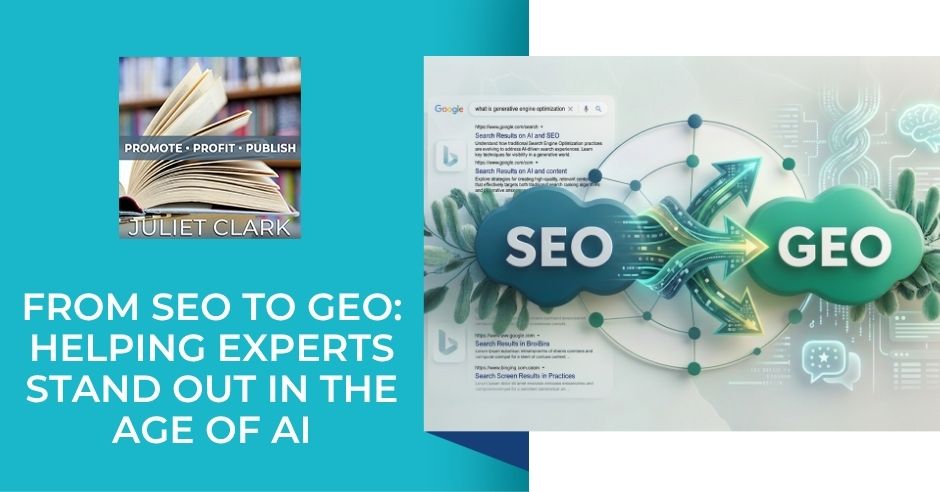
From SEO To GEO: Helping Experts Stand Out In The Age Of AI
Our guest is going to be very intriguing for those of you who are content creators. Amy Yamada is a keynote speaker and an AI visibility strategist who helps authority-level experts get accurately understood, found, and recommended by AI platforms. With 25 years in marketing and communication, she teaches leaders how to turn their expertise into a message and structure that AI can understand so that they can become the trusted, go-to choice in their field.
For those of you who are thinking, “I don’t need to do anything different in the AI content world.” You would be surprised. I’m doing a training along with Podcasters United on how to do ads that are AI-compliant, because when we use Google, a lot of times they aren’t. It’s blocking the system. You do have to make some revisions and hopefully, Amy and I will discuss that. Stay tuned for Amy.
—
Amy, welcome. I’m so happy to have you.
Thank you so much. I’m thrilled to be here.
I love what you’re doing in the AI space. Many authors think that AI, using AI is not for them because they get into this headspace that, “I can’t write a book with AI,” which they shouldn’t. There are all these other things we’re going to talk about where they can use AI effectively. I’m excited to talk to you about it. You spent years helping entrepreneurs clarify and communicate the value of their work. What experiences led you to AI visibility and the GEO space?
Bridging Authentic Messaging with Artificial Intelligence
My team and I dove into AI when ChatGPT very first dropped. There’s so many businesses that have been around for so much longer in the world of AI. But I’ve had my business coaching business for about fifteen years now. When about the journey that has led me to what we’re focusing on now, there’s always been a through line around authentic messaging, authentic marketing, and deep human connections.
You don't have to sacrifice authenticity to leverage AI in your business. Learn how to bridge human connection with smart workflows. Share on XIt’s a little bit ironic that I’m now in the AI space. What I’ve worked hard to do is to bridge those two together, bringing the human element into AI, meaning that I understand why people are, sometimes still to this day, resistant around using AI. I was resistant at the beginning myself because I’m all about authenticity. I thought, “If I’m using this, then even just the word artificial makes me cringe.” It still does to this day. I don’t love that word. However, to me, there’s so much more that we can do with AI than just letting it replace it.
It’s not about replacing us. It’s more about how we choose to use it. Over the years, I brought all of my authentic messaging, marketing, and components into AI so I could give it that context. It was more about making these workflows and tasks more efficient. Versus prompting it to do something for me and letting go of the human element.
I know when I write fiction novels, a lot of times, I’ll put them through. What I love about it is that if you write a 400-page mystery novel, you’re going to have inconsistencies there. I can put it through and say, “Give me a list of all the inconsistencies in here,” so I can go back and correct them, which I never had before. I’d have to read the book and read the book. There are a lot of good uses for it. What did you see changing in how people discover and choose experts that made you realize this is something that was urgent in your world?
Navigating the Shift from Traditional Search to Conversational AI
I’m trying to remember exactly when this happened, but I want to say in the last eight months or so. There was one conversation that I had with a colleague and friend of mine who runs a mastermind for 7, 8, and 9-figure founders, business owners, and experts. He was saying that website traffic across the board for the most part is going down because more people are going straight to AI to ask questions and get answers, solutions, and even recommendations.
I thought, “This might be a time to look into that because another shift is happening.” Sure enough, it is. It takes me back to when we went from the Yellow Pages to the internet. There were a lot of businesses who were advertising in the Yellow Pages, or they at least had a listing in the Yellow Pages with their name and what category they were in, their address, and their phone number. That’s how they got business.
This thing called the internet came about and these websites. These businesses were like, “Do I need this shiny new thing? It’s probably a trend.” Sure enough, those who took advantage of getting online first had that longer-term benefit. We’re in another transition where more and more people are going to these AI large language models to ask these questions, have conversations and to figure out what is the best solution.
If they ultimately choose to invest in something or buy a product, program, service, or something, then they look like, “Who can I find through AI?” That’s where I thought, “This is something that is going to be the next big transition.” We started to dive into that. With these experts, content creators, authors and thought leaders, how can we make sure that their content and their expertise is not invisible to the AI models? That’s where we got started.
You probably don’t know this, but there’s a big scam in the book world. These book marketers with Gmail addresses. It’s funny because I will get emails from them since I have lots of books out there. I will cut and paste the email into AI and say, “Fake or not fake? Who are these people?” They’ll always go right to that email address and go, “Fake. Real companies have real dot-coms.”
It’s exactly what you’re saying. I use search. How do I do this? What should I do? It makes a lot of sense. I’m assuming the way you’re doing this, like if you ask about books, it might tap into my content or another publisher’s content to get that help there. That is a good thing. How would you describe the human times AI movement? What do you hope to change in the way people adopt AI?

My hope is that people recognize that this is something that can help them like a team member. Again, I don’t want to look at it as replacing humans because I still have an incredible human team. I love working with them. They’re very talented, brilliant people. If we look at anything that can be accelerated or be more efficient. I like to ask my clients, they will say things like, “What are tasks that you do over and over again that there’s a process involved and that you can delegate it to AI to do it for you? As long as it has all the context it needs to do it the way it makes you want to do it.”
Understanding Why AI Models Seek Human-Sourced Content
Having that human and AI collaboration can be powerful. When it comes to visibility, AI models are looking for human-sourced content. I know a lot of times people, when they think of AI, they think, “Now people are just using AI to communicate for them or write for them. It doesn’t even sound like them anymore.” AI does want to find human-sourced content. With the clients we work with, we love working with thought leaders and people who have built and are continuing to grow a body of work in their own voice.
Bring all of their content into one place and basically make it so that it’s AI visible. A lot of the content that people are putting out there, AI models can’t see. If they can see it, it’s loose information that’s fragmented versus it being organized in the way that AI wants to see it. There’s this component of bringing humans and AI together to collaborate. Also, for those of us who are creating content and wanting to grow our visibility, then it’s about structuring everything in a way that AI can see it.
Let’s talk about that for a minute because that’s what you guys do. Why is it that when content is out there, AI can’t see it?
Structuring Anchor Entities to Eliminate Digital Invisibility
It can see some components of it, but it’s like loose information. First of all, it’s looking for what we call anchor entities. The way I like to simplify this is that websites are still very important. It’s almost like you have an address. You have a web address. Think of it as having a home address. You’ve got this address, but then AI can see the house, but it can’t see what’s inside the house.
It’s about having things organized in a way so that AI can see things labeled properly and also how that connects to you as a person. You as a business owner, an author, as a speaker, or whatever it is that you are. What is it that you offer? How do you help people? How do you serve people if that’s your business? If you go into ChatGPT or Claude or Perplexity and you put in your URL and say, “What do you see?” It will be able to read the text that’s on there. It does struggle. Sometimes people will post testimonials or endorsements where they grab a screenshot of something and they put it on their website.
Sometimes those are harder for AI to see. My understanding is that they can’t see it so it’s better to have it in text format instead of an image. To bring it all the way back to these anchor pages or anchor entities, ideally you have a solid homepage, about page, and service or services or products or books. Whatever it’s that you offer. A page that is about what you do and what you offer. That way, you can see that this is a person that owns this business or this website that offers these books or these services or these offers. Whatever it may be. That way, it’s organized in a way that is very cohesive and where I can see that all these components are connected.
I know. I use Perplexity a lot. I have to go to computer versus search because I’ll say, “Go look at this page and tell me how I can make it better.” It will say it can’t see the page. When I go into the computer, it will ask permission and go look at it. Sometimes you have to upgrade a little bit to get the right answers. Let’s talk about daily tasks, though. I know Perplexity, I have it programmed. It reminds me or tells me when a new book fair is coming up. I can program it to give me reminders on things as well.
There’s all sorts of things you can do. I always recommend that people make a list of what are the things that you do on a regular basis that you wish would be a lot more efficient. That way, you can think about, “What are the tasks that I do repetitively every day that I have a process around?” That’s a perfect example. The other thing, and this gets a little bit more techy for those who are techy. I don’t even consider myself a techie person, even now, knowing what I’ve done over the last few years. Maybe I would be considered more techy.
AI models actively search for human-sourced expertise. Structure your body of work so algorithms can accurately read your voice. Share on XAccelerating Custom Tool Creation with Conversational Coding
What I mean by techy is that I don’t know how to code. I’m not a coder. I’m not a developer. However, I now know how to develop using AI. Some may have heard the term vibe coding. I vibe coded this platform in two hours. You can use it like Claude Code, or I was playing with Replit. A colleague of mine told me about Replit. I just went through and you can just prompt it to create anything for you. If you want to build an app or a website.
Basically, I created a lead tracking system. You were talking about events. Think about, “What is it that I want to build that can track things for me?” You can go in and just prompt it in normal human communication language, then have it built something for you. As it’s building, it will show you a preview of what it’s building. You say, “After, can you change this or do this or do that?”
It’s incredible to think about how, in the past, you would have to hire a team of developers and invest thousands, if not tens or hundreds of thousands of dollars and take weeks, if not months, if not years to build something. Now, we can do it sometimes within hours. It’s just powerful to be able to identify what are the tasks I do repetitively or repeatedly and how can I have AI create something for me. I always joke around with my clients and my friends. I always say, “AI secretly stands for Ask It.”
Any question that pops up in your mind, even if you’re like, “I don’t know. What would I even come up with?” You could just go to one of these large language models and just say, “I want to start using AI to save me time. Here’s the type of business I have or here’s what I’m focusing on. What are some ways that I can use AI to simplify this, streamline, accelerate this, or make things more efficient? It will give you ideas. You can just pick one of them and run with it and have it build something for you. It’s incredible.
It is cool. We built an advanced reader copy system that we can put the book in. We have all these people signed up to be advanced readers and it goes through a process of reading the book and choosing which one of those readers we should offer to have them read the book. It matches the genre to the reader. I don’t have to read the book, which saves hours.
I love that you mentioned that because that’s something that still people miss as an opportunity. They often think, “AI can create for me or write for me.” It can read for you, too. If you have something lengthy that you don’t have time or don’t want to prioritize, go through it. You can upload it into one of these AI models and have it summarize it for you or ask it questions. You can engage with a document or engage with a book to say, “Give me the main points or what happened here.”
It can feel a little bit funny at first. It’s like, “I feel like I’m cheating.” If you think about any evolution of anything, at some point we got calculators. I don’t know about you, but I do not want to sit down and do any long math. I grew up in Japan in Yokohama. I was born and raised in Japan. I’m half Japanese. I went to an American school, but we still took certain Japanese classes and Japanese culture. Even in elementary school, I had a class called Soroban, which is the abacus with the beads.
I remember it wasn’t because we needed to use that, but it was just part of the culture. We learned how to do math on these Sorobans. These abacuses. There were actual competitions where you would go and see how fast you could do it. It was just amazing. Some of these kids were so fast. However, I’m so glad I don’t have to do math on a Soroban. Can we imagine life without just a basic calculator? Now we just have it on our phones. It’s just amazing. Even though there are times when I’m like, “I feel like I’m cheating.” I bet people when they first started using calculators, they probably felt the same way.
I’m sure they did. I’m a lot older than you, but back to my first jobs when I worked in a burger joint. We used to have to count the money back because we didn’t have a register to do it. Now, if you walked into a fast food place like In-N-Out. Those kids are not going to count back 3, 4, 5. They’re just going to say, “The cash register said $5.41 back.” You don’t get that anymore. You also are a generative engine optimization specialist, GEO. Tell us what that is, because I know a lot of people have heard of SEO, but I don’t think people know what GEO is.

Think of GEO as having your online content to be seen and understood by the AI models. Before AI can even cite you or recommend you, it needs to be able to see you and understand you. That’s where we come in terms of making sure that our clients’ content is visible. Here’s what I’ve noticed over the years. I have my clients that already have built a significant body of work. They often have YouTube channels and podcasts. They’ve written books. Oftentimes, they have success stories and endorsements. They’ve been in the media. They have spoken on stages.
They often have a lot going on for them. For those people, then we have plenty of content that we can break down and make visible for the AI models. There are those who haven’t yet built up that bodywork, which is fine. We’re all on our journey. They are wanting to create that visibility. They are wanting to put themselves out there. Some of them do get that AI is important. GEO is important.
Before they get into the techie side of things of what needs to happen on the back end of their website, they need to still focus on the front-facing website. What I mean by that is thinking about that homepage, about page, service, or offers pages. In those offer pages, you got to think about what is the clear message that you want for both humans and AI to know about you. One of the first things I ask people is, what do you want to be known for? Maybe it’s something you’re already known for, but we want to make sure it’s so clear and specific on your homepage.
That way, humans and AI both understand this is a person who helps these people or writes about these types of books or does this thing. This is how. It has that clear positioning statement on the homepage. When it comes to GEO, first, I always talk to people about your front human-facing pages and making sure that they have certain pages dialed in, clear and structured in a way that is optimized for AI visibility. We talk about the backend. What I mean about the backend is where your code and HTML and all that gibberish lives.
Once the front facing is dialed in, we’ve got to put in this thing called schema. I like to think of it as like a format of code and information that makes everything visible and connected the way AI wants to see it. It can feel overwhelming at first if it’s not something you or anyone is familiar with. Once you get the foundational components dialed in, it’s easier to add on those layers. You’re basically creating a large AI digital footprint to create all these pathways back to you.
If you ever think that your messaging may not be clear, go ask AI to write a bio for you. If that bio doesn’t land at what you think because perception is reality. I always tell people this with brands from advertising. Only because you think that’s what your brand is about, it’s more the perception of what the audience thinks it is. We had a book we put into our program that our author kept insisting it was a romance novel. AI kept reading it and said, no, it’s historical fiction.
It was very difficult to get her to acknowledge that the book wasn’t being received. If you looked at the reviews on Amazon, people were saying the same thing, “I expected romance. I got historical fiction.” You do need to do that research and make sure that AI’s perception of you is what you think it is. What does it mean for an expert or business to become AI-recognizable versus AI-recommendable?
Moving from AI Recognizable to AI Recommendable
AI recognizable to me means having your online content be even visible for AI to be able to see and read it. To be recommended, AI is looking for trust signals. It’s looking for those success stories or testimonials or endorsements. Third-party endorsements. Maybe if you’ve been in the media, having that information linked to your website is powerful. The reviews are important as well. When AI can see enough trust signals and it sees you as the go-to person for what humans are asking about, that’s what makes you recommendable.
It’s something that for some, is something to work towards. Everyone can at least work on the foundational components to become visible and recognizable first. The way I like to simplify it is, even before AI, it’s like with humans. If they don’t know you, they can’t recommend you. They’ve got to know you first. There’s that whole phrase we probably heard a million times, the know, like, and trust factor. We don’t have to have AI like us, but we do need it to trust that we are saying who we are and this is a legitimate business or author or person, or organization.
Building custom business software no longer requires months of development. Discover how simple prompts can build tools in hours. Share on XThere’s so many parallels to how we show up for humans. Having a clear message has always been important for humans. Having clarity in your offers or categories. What you talked about with the book examples was so interesting because if we don’t have that clarity, then we can be misunderstood. It’s the same thing with AI. We want to make sure that it does understand who we are, what we do, who we serve or who’s our target audience. If we’re authors, what do we write about? Clarity of messaging is more important than ever. That way, first you become recognizable and then you become recommendable.
I would think if you went into AI and said in your field like, “Tell me the top five people in this field that you would recommend,” and you’re not in it. It’s time to go research what they have going on that you don’t as well to get to that point. You could hire me. I think you already asked my next question. What does a clear entity identify as a founder, author, consultant, speaker, or coach? If somebody wants to have that clear entity identification, what do they need in that background?
First of all, entities. I will sometimes hear that word like, “What does that mean when it comes to AI?” I like to think of entities as the smallest building blocks that make up your body of work. You can break down entities in these small units of information. Whenever I host a masterclass on this, I always say, “Everything’s an entity. I’m an entity as a person. My website’s an entity. This micro topic underneath a subtopic is an entity.” Everything can be broken down to these entities. We want to make sure that every entity is part of the building block of your body of work.
The three main entities come back to the anchor entities, which are the homepage, which is what, in the AI world, it’s like your organization entity. How is your business or your personal brand organized? Your about page is your personal entity. That’s where you describe yourself as a person, your credentials. Your story, perhaps or how you work with people. That’s your personal entity. There’s the service or services. I always like to talk about service offers.
I know that not everyone is a service-based entrepreneur. That’s who I often work with but what is it that you are offering the world? Having those entities clearly identified as well. Once you have those anchor entities, I like to think about them as the pages that we need to have first and foremost, then you’re able to have a clearer foundation for those trust signals to be able to happen.
That makes a lot of sense. We have reformatted the way we do about pages. Everybody’s over the LinkedIn style, “This is what I do. I have three degrees from MIT.” We do a lot of storytelling in that, your origin story because it does make you human. People know AI didn’t write it, then for that. Let’s do something practical here. If someone has only one afternoon to begin improving visibility, what is the first thing they should review or change?
I would say look at your homepage on your website and ask yourself. If even a human had five seconds to look at your homepage, would they immediately be clear on who you are, what you do, who you help and how you help them or who you serve and how you serve them? Again, you can revise my question in whichever way most aligns with you and what you do.
Be honest with yourself. Do you have a solid positioning statement on your homepage? Ask it. AI stands to ask for it, as I said earlier. If you’re not sure, then you can go to your favorite large language model and put in your URL, or if you don’t have one, I know a lot of people are either building or rebuilding or revising their websites. Say, “I want to create a clear positioning statement that is optimized both for AI visibility and for humans.”
Give it any context you need to give it about yourself and/or say, “Ask me questions one at a time before you have enough information to create my positioning statement for me.” Something like that. It’s like you’re having a back-and-forth and let it write it for you until it sounds aligned with you and reflective of what it is that you do. Having that statement somewhere on your homepage would be ideal as a starting point.

We know from what we do here that you can code that page for you. We do it all the time now. We do a mock-up and once it’s perfect, we say, “Code it.” That is so easy now. It’s unbelievable. I do feel like I’m cheating, but I have hours every day that I’m not working now. It’s a big benefit. Future and leadership-wise, what ethical risks concern you the most about the business rush to optimize AI?
That’s a big question. What concerns me, as much as I love AI, in that world, there are things that are concerning to me. The way in which people use it. If they’re completely becoming codependent on it, where AI writes all of their content for them because it can. It’s almost like they’re losing that brain practice of your own creativity, your own human being that I believe is so valuable still to this day.
Protecting Human Intuition and Authentic Creativity
My wish for the world is that they don’t let AI take over who they are and their own unique intuition, intelligence, brilliance, and creativity. That they think of AI more as a collaborative partner and a resource than something that is replacing them. Leave the creativity to the human.
We just referenced that calculator. None of us can add in our head anymore. It’s embarrassing to go out with your papers.
At the end of the day, being human is such a gift. Think about the things that AI cannot do. I did a talk. I did this keynote talk on a stage, and I looked up more on the human side of things. There’s a book about this, like the top five things people say when they’re in hospice, when they’re at the end of their life. I talked about how all of them are reserved for being human. I don’t remember all of them right at this moment because it was a little bit ago that I did this talk.
It was about being authentic to who you are. It was about spending time with people you love. It was about taking risks. The things that are most important. As much as I’m such a passionate entrepreneur, I put a lot into my work and I love working with my clients. At the heart of it all, it’s about being human, how we treat one another, and how we show up in our lives.
I always like to think about how I want to show up as a human on a daily basis and leverage AI for things that I wanted to do alongside me, but never to replace me and never to lose sight of what’s most important. I think about that a lot, just in this human being experience that we’re all in that is adventurous and has its peaks and valleys. When we go through life awakening experiences, it opens us up to like, “This life is precious.”
If people want to find you, work with you, find out more about what you do, where do we find you?
Everything’s under my name. It’s just AmyYamada.com. With Facebook or Instagram, it’s all under Amy Yamada. I do have another site now with what we’re working on with our authority-level clients, and that’s called TopAuthority.ai. If they want to reach me, you can just DM me through Instagram, which is at @AmyYamada.
Treat AI as a collaborative partner, not a replacement for your human intuition and unique creative authority. Share on XI love connecting with people and seeing how I can best support them. Especially those who have a message to share with the world and want to make sure that, as this shift is happening, that they make sure that their content and who they are and what they do is visible to the AI models. Humans are using AI and AI is connecting humans with humans. Let’s make sure that we’re not lost in the shuffle.
I’ll wrap it up with this. The funniest thing is, since I started using AI, I don’t like social media. Social media seems messy, like messy human emotions to me.
It’s so true. I think about how cluttered it feels if you’re scrolling on some of these platforms. It’s a lot of ads and a lot of stuff that is just not important. Whereas with AI, you’re going in with your own unique perspective, questions, and conversations. I find it fascinating. I love using AI to help me prioritize my day.
I’ll just do a brain dump just into ChatGPT or Claude and just say, “Here’s everything that is on my mind. Here are my time-specific commitments for the day. Here are the things I want to do. This probably is more like a week’s worth versus a day. Help me prioritize what I focus on while still having time to work out in the morning, have lunch break and go for walks and have spaciousness.”
I love how it reflects back and helps me prioritize. It creates my power plan for the day, as I call it. I think of it as a great accountability buddy. Now that I’m thinking about it, I’m jumping ahead to five steps, like, “I could use Claude Code or upload and create my own app that will just do it.” Anyway, I’m getting ahead of myself, but that’s the fun of AI. You can create things, as we were saying earlier, and make everything easier.
My AI scolds me, which is hilarious. It’s like, “You did eight miles yesterday. Do you think you need eight miles today?” I’m like, “Jude, who asked you?”
You’re like, “That’s up to me, Jude.”
You can tell I call my perplexity Jude all the time. I don’t know if I’m supposed to name it. Amy, thank you. This has been wonderful and informative.
Thanks so much for having me. It’s been a lot of fun.
Important Links
- Amy Yamada
- Amy Yamada on LinkedIn
- Amy Yamada on Facebook
- Amy Yamada on Instagram
- Podcasters United
- ChatGPT
- Claude
- Perplexity
- Replit
- TopAuthority.ai
About Amy Yamada
 Amy Yamada is a keynote speaker and AI Visibility strategist who helps authority-level experts get accurately understood, found, and recommended by AI platforms. With 25 years in marketing and communication, she teaches leaders how to turn their expertise into a message and structure AI can understand – so they become the trusted, go-to choice in their field.
Love the show? Subscribe, rate, review, and share!
- superbrandpublishing.com
- Promote, Profit, Publish on YouTube
- Follow Juliet on LinkedIn
- Take the Quiz!