Many non-fiction and fiction authors struggle with stagnant book sales because they focus on designing pages rather than driving consistent visitors. In this session, host Juliet Clark breaks down why Amazon algorithm changes require external visibility rather than internal site ads. You’ll learn how to replace random marketing tactics with a repeatable multi-channel strategy built for long-term growth. Juliet explains the exact framework for building an email list through targeted reader magnets, newsletter swaps, and group promotions. Discover how to leverage advanced reader copies, meta ads, and podcast appearances to transform your book into a qualified lead engine. This strategic blueprint gives you the tools to create a sustainable sales rhythm for your author platform.
—
Watch the episode here
Listen to the podcast here
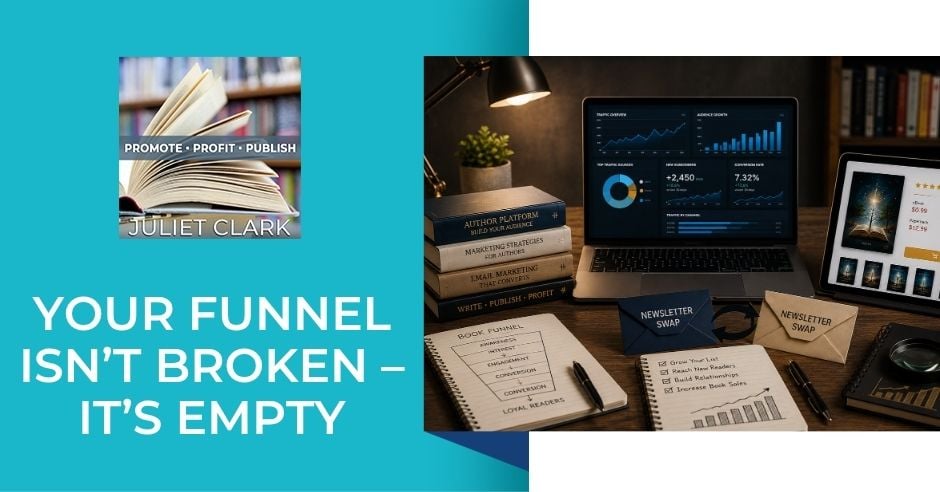
Your Funnel Isn’t Broken – It’s Empty
Welcome to the show. We did a webinar with Your Funnel Isn’t Broken, It’s Empty. We talked about ways that you can build your own audience for Amazon with external links, because that is what you need. Stay tuned.
‐‐‐
Welcome to Your Funnel Isn’t Broken, It’s Empty. What we’re going to talk about is how to drive the right traffic to your book, your list, and your business. A lot of you have been flummoxed over, “Why am I not getting any traction over on Amazon?” That’s where most people purchase books. The answer is because they changed their algorithms. For a lot of people, they don’t even know this. I’ve been talking to other publishers in the last couple of months, people who sell book marketing, and they have no idea this happened. That also flummoxes me as well because those are people who are not staying up on the industry.
Reframing the Real Problem Behind Low Book Sales
We’re going to jump into it. The one thing I’m going to tell you about what I’m going to talk to you about is that I know this works because I’ve been using it in my own books. I brought it to you guys when I knew it worked. The real problem here is that most people don’t have a funnel problem. They have a traffic problem. What that means is we have built pretty pages. We’ve integrated our email with a very polished design, but zero humans are showing up.
I know for many of you who are nonfiction authors, that’s a problem because that book bringing those people into your funnel is the warm-up to you getting them into your bigger programs and services. If you’re a fiction author, it’s extremely frustrating because fiction is so much harder to sell than nonfiction. You have to get people interested in your characters and what you’re doing.
What happens with this is people have the wrong diagnosis. The authors try to fix their funnel when the real issue is why people aren’t entering it. In this episode, we’re going to talk about the fix that you can use to fill that funnel with the right readers there. What you’re going to walk away with is a simple reader funnel that works with one clear system from discovery to subscriber, and then I’m going to give you five repeatable traffic channels.
Truly, the repeatable part of this, you’re not going to do it once. You’re going to keep doing this month after month and keep filling that funnel. It’s layers with a rhythm. It’s not a whim. We’re going to talk about a weekly rhythm, what works, and what doesn’t work, and then Amazon optimization. I know for many of you on the call, I’ve already done your Amazon optimization. You’ve already done that part of this journey.
Let’s jump in. One of the things that happens when you guys publish is you don’t understand that your book is not the product. Your book is a product, but your business is the actual product. A lot of you on here have already published books. You’re going to get $1 to $3 a book. Where you’re making your money is the items that you sell afterwards.
Treating Your Manuscript as a Gateway Engine
Getting people into that funnel and warming them up is very important to get them from a $30 product, that book, into your $2,500, $5,000, $7,500, $10,000 program, or whatever that looks like for your business. That’s where the money in this lives in this equation. Stop treating the book like a lottery ticket. I know so many of you do. It is a lead engine. I mean that even when you’re a fiction author because you’re leading people to your next books and getting them excited. I want you to think about your book as the front door, and we’re opening the door to what’s possible inside your business with that.
Your simple reader funnel is going to be a reader magnet, a welcome sequence, and that email opt-in. That reader magnet doesn’t have to be your actual book. I have a couple of people on the call who have larger books. One’s on parenting. Another one is medically related. What we did is we created a smaller book to get people into the funnel.
We have a nonfiction short book to get their attention and see what they’re all about. If you’re a fiction author, that reader magnet should be something like a novella. If you have your first book written but you haven’t published it yet, create a prequel. That tells people about the stories you tell and the characters. It gets them interested. If you already have multiple books as a fiction author, give one away. We have authors who are working with me that we’re doing the same thing. I gave away a free book using this exact sequence I’m going to show you. I put 290 new people into my phone. That is a great beginning for anyone.
The first thing you’re going to do is optimize your content. If your book is on Kindle, this depends on whether you have been traditionally published, hybrid published, or self-published. If you’ve been traditionally published, your publisher is probably going to do this for you. If you are hybrid published, the only way you can do this is if your hybrid publisher puts your Kindle eBook into Kindle. That is important because that gives you a lot of control over your ads and your optimization. It allows you to get into Kindle Unlimited. It gives you a lot of benefits.
Unfortunately, most of the hybrid publishers are not doing this. Those of you who work with me know that I do that because I do want you to have control. If you’re at an event, and your book is $9.99 on Kindle, and you’d like to price it at $2.99 for the day for this special event, then you have the ability to go ahead and do that.
A+ Content is under the new Amazon algorithm. What they’re looking for is no longer those bestseller spikes. They’re not giving that much credence anymore. They want to see consistent sales, and here’s the key, from external traffic. What that means is those links to your book that have been driven from a talk you’ve given from a stage, a podcast you have, a blog you have, podcast guest situations that you’ve been on, or gigs. They’re looking for you to have a platform that promotes your book yourself, and that you’re bringing in those links yourself.
Adapting to Amazon External Algorithm Rules
When you put your A+ Content with your book on Amazon, you are signaling to them, “I am a content creator.” What they are rewarding are those external links and content creators. I know a lot of people on the call have podcasts. That’s perfect. Your book should be the call-to-action on every single podcast you produce. I know some of you on here have blogs. That’s another great way to do it. Also, swapping and doing guest blogs, or swapping and doing a guest podcast.

Those links should come externally. If you’ve tried doing any Amazon advertising, it’s a waste of time because those are internal links that they’re not considering as much. I talked to a bunch of mystery authors in the last couple of months because I tried advertising on Amazon. It went nowhere. It was bad. This is an opportunity. You have access to either do it yourself, or you can have a professional do it. That is one of the things you should do. Get that optimized and build out that A+ Content. Let me go back to that for a minute, too.
You guys have produced books, so you probably know you’re getting a ton of emails with people asking to optimize this. Be careful hiring those people. There are so many scams out there. I opened my Gmail, and I had four people. I had six not long ago. You can tell they’re scams because they have Gmail addresses. Real businesses in the publishing world have dot-com or dot-net addresses.
I have had some clients who have had these teams optimize versus what we optimize. We had two authors that had trauma books. For the one we did that was informational versus one that these optimized teams did that looked like a big sales page, ours got 40% more clicks. Both of those people advertised with us. When you do this, don’t make it all about sales. Don’t make it all about you. Make it informational about your book.
The next thing is your number one traffic channel, which is your email list. This is where you’re going to use the audience that you own. A lot of what I’m talking about here in filling your funnel is exactly this. Itold you that I got almost 290 people into my funnel. I sent an email out to those 290 people and offered them an opportunity to read my book coming out and leave reviews on Goodreads and Amazon. One of the things you’re going to be using this new email audience for is to communicate with them and preview it. Get your email list built. I know a lot of you have complained that this is hard. The way I’m going to show you is much easier. I’ve even had an easier time than building it in our home.
The reason that this is the only audience you own is that Amazon changes the algorithms. They did in 2025, and people are complaining right and left that they’re not selling things. They’re not selling things because they didn’t build their platforms. The social media platforms are throttling reach as well. Facebook is not too bad. It’s pretty hard to get books sold on LinkedIn. It’s a very busy place. If you’ve noticed on LinkedIn, when you put a link in there, they change the actual link. It’s not as apparent where they’re going, so a lot of people won’t click.
Ads have stopped converting unless you’re doing good Facebook ads, but your list stays. Your email list is people that love what you do. They’re downloading that free mystery novel because they like it. They’re downloading that free eBook that you’ve done because they like it. They are the right audience. Your email list is consistently going to outsell social media and other offers for your book. This is the traffic channel that you should be focused on building. If you look at this and say, “I’m not going to build this,” this is the one you should build without fail.
The next traffic channel is book swaps. I have several people on a website, and those several people are on this call. What we’ve done with book swaps is as soon as their list gets to a good enough size, we go in. People list opportunities on this site for you to share their books, and they share your books. I built 89 new people into my list by doing this. I use my newsletter every week, and I made them the featured book. They did the same. These are free downloads of either that mini book, or I gave away a full book.
This is another great way to get your list full of the right people because you’re going into a genre-specific audience. It’s a thriller. It’s whatever that book happens to be. I talked to somebody, and it was fantasy. You’re swapping with other fantasy or other nonfiction people in a way that builds that audience. It’s a true match. It’s not hit and miss.
Scaling Reader Reach with Strategic Newsletter Swaps
The match on this is audience quality. It’s not the size of the list. A swap with 500 perfectly aligned readers beats 5,000 of the wrong readers any day of the week. I know a couple of you here have businesses. If you’ve been in business for a while, you’ll remember we went through a phase where if you wanted to speak on an online event or a stage, the first thing out of the host’s mouth is, “How big is your list?” They wouldn’t take you if you had a small list.
That’s not the case here. Everybody is trying to build. It doesn’t matter if you have a small list or a large list. Find partners. You can find a lot of these people if you look in genre-specific Facebook groups and author communities. I use BookFunnel. StoryOrigin is another platform you can use. I don’t use it as much. I didn’t care for it because I liked BookFunnel.
If you want to find out how good they are at this, sign up for their list. See if their voice and their audience match you. If it is, it’s a good swap. I got lucky with my very first one. I chose somebody who had the same last name I did. She had a killer list. She was the one who put 89 new people into my list in one swap. It’s something you should be using because you’re going to have the right readers. If you’ve been in the nonfiction world for a while, you know there are people who don’t want to pay for something. They’re going to opt in for free. You’re getting the right people in your list.
The next traffic channel is group promos. I put one of my authors into a group promo, or we’re still waiting on approval for it. What this is is that over on BookFunnel and StoryOrigin, there are many genre-specific opportunities over there that share one promotional event. Kindle does this a lot over there with the group promos. They might have a wellness list for the month of July. They have these promos every single month over there. That’s why I said I’ve been doing this every single month to build the list.
Many authors share one promotional event. The one I tried to put my people in had 22 books there. That means all 22 of those people have this out on social media. People are coming. They’re seeing your book and clicking and downloading it. Each reader enters an individual funnel of yours. If they click on your book and somebody else’s, they’re entering two funnels there.
Your welcome sequence takes it from there. Once they’re in your funnel, then you are bringing them in. You have the opportunity here to either build your list or drive sales. I would choose the list over the sales any day of the week because of the way that Amazon and the distributors keep the transparency to themselves. If you do it this way, you’re going to build your list and possibly bring these people into other things.
Your book sales problem isn't a broken funnel. It's a total lack of consistent traffic reaching your page. Share on XIf you try to drive sales with it, you’ll probably get sales, but you don’t know who those people are. It’s a one-off. You’re not going to be able to tell them about your next book. You’re not going to be able to tell them about what’s next if you’re a nonfiction author. You have sales group promos and things that you sell, like coaching programs.
Number four is ARC and review services. ARC is Advanced Reader Copies. This is valuable for you to do because you’re not getting your individualized group of people in your list. You’re getting third-party people that don’t know you. I tell people all the time, “When you’re giving out advanced reader copies to get reviews, don’t give them to your family. Your family is not going to tell you if it’s good or not. Avoid giving many to your friends because your friends don’t want to hurt your feelings if it’s not great. You want honest feedback. When you start this in the right place, you can make changes to your book quickly if you need to.”
The first place I would go 90 days out is NetGalley. NetGalley reaches professional reviewers and librarians in the pre-launch phase. You can get professional reviews there if someone from the press reads your book and decides to do an article. I don’t know if you guys know this, but I had a big blogger who blogs for a lot of the big companies in New York. He came and did a feature on Dark Granny. That’s the way he found me.
Another good one is BookSirens. BookSirens is very particular. The first time I tried to get with them, they rejected my book. The second time I mentioned that I was going through NetGalley, they took my book right away. The reason is that BookSirens is looking for great books. They know that you are a professional if you are engaging in NetGalley. They know you’re a serious author.
The third one is Booksprout. This is a review team that shows up on launch day. If they have pre-read your book, then they will start going in and leaving reviews on launch day, which does help your algorithms right away. The other thing I want to tell you is that because of all these changes, your sweet spot with reviews is you want between about 25 and 40 reviews right off the bat. You need to build some big teams to get that kind of traction because not only are they looking for reviews, but they’re looking for verified reviews. That means these people need to buy your book. Otherwise, it’s not considered a valid review, and it will hurt your chances in the algorithm.
Then, Edelweiss. I don’t use that as much, but that’s another way to reach booksellers, trade reviewers, and get a broader reach. That’s something you want to do if you want to get in bookstores, which I don’t always recommend for most books. One thing that publishers don’t tell you is the returns are brutal when you get into bookstores. Don’t base everything you want around bookstores because you could get a bigger bill than the royalties you made getting into bookstores.
Gathering Third-Party Reviews for Social Proof
The truth is, unless you’re on an end cap, you’re probably not going to get found in that bookstore. What these early reviews are doing is creating social proof on launch day for you. The reviewers become readers. The readers become subscribers. You want to do this a good quarter out from your book launch. You want to have it in presale when you do this so they can find it.
Traffic channel number five is paid ads. When it comes to paid ads, I don’t even bother with Amazon anymore. If you look at your Amazon page, most of it is filled with ads. If you know anything about digital marketing, when you have too many choices, you don’t know what to choose, and you walk away. I am not going deep on Amazon ads anymore.
For Meta ads, if you have great targeting, you know exactly who your reader is, and you already have a list, this is a great way to go. For Bad Lie, I already have a list of golf readers and mystery readers as well. It’s a golf mystery. The whole game of golf is a mystery to me, but that’s a different story. The Meta ads are great because I can put that list into my Meta ads and say, “Give me a lookalike audience,” and it will go out and find more of the people that are the same criteria.
The other thing you can do is BookBub Ads. I thought they were okay. I didn’t think they were fantastic, but they performed better than the Amazon ads. This is important. Paid ads are there to amplify the system that you’re building. They don’t fix a broken system. If you haven’t built all this up, I wouldn’t even bother to run ads because they’re probably not going to get to the right people. The point of doing it this way is to get genre-specific people instead of randomly putting marketing out to everybody and hoping you catch someone.
The sixth channel is speaking podcasts and content. Every piece of content you put out there should have a link to your book. Every piece that you have, you should be repurposing. If you have a blog, do a vlog with it or a video piece and put it over on YouTube. Have your book there in the notes for every single video that goes out. Have it on your blog as a call-to-action. Have it on your podcast as a call-to-action. If you’re out speaking, direct people to those pages to buy that book. If you’re speaking, take books to the events so that you can sign them, but be sure you have a mechanism to get those people who buy those books into your list as well.
You should have one specific, clear link to do this. Don’t tell people, “Go over to Amazon and find my book.” I’m going to give you a great example. People spell Juliet several different ways. They spell it as Juliet or Juliette, the French way. If you go over to Amazon and don’t have that author’s name spelled the right way explicitly, you’re not going to find that person.
I’m going to pick somebody on the call that we ran into. Peter Boland, PhD. When we looked up Peter Boland, there’s a fiction writer who is all there. He has tons of books. Everything Peter does should have Peter Boland, PhD, so that people know exactly where to find him. That’s why you have a clear link, even if you have to go by the URL, which is the name of your book. Maybe it’s DarkGranny.com. That’s the way you do it, so when people go there, it’s forwarded right into Amazon for them to buy your book. Make sure that you use a URL that helps people find it so they don’t have to search because they won’t search.
When it comes to your content, repurpose everything. Have it as a video, an audio piece, a blog, articles, memes, or whatever you need to do. Have that URL to find your book on everything. Then, borrowing audiences. That’s why you get yourself speaking gigs, because you’re borrowing the person who’s hosting the event. You’re borrowing their audience. When you do podcast swaps, or you’re a podcast guest, you’re borrowing their audience. If you are a guest blogger, you’re borrowing their audience. Make sure that you’re booking on a constant basis to borrow other people’s audiences and get them into yours.

There’s a hidden channel here for those of you who have multiple books, and that is the backlist. A lot of times, we forget about those books we wrote previously because we want people to focus on that current book. That backlist is a perfect place for you to take a book you’ve written before and make that a free book download.
If you read a lot of fiction, you probably do the same thing I do. I find a good book, and then I go back to that author and see what else they’ve written. Make sure that you have all your books on your website. Make sure that you utilize your backlist so people find those books as well. Unfortunately, people don’t understand that a book is a lifetime marketing goal. You can’t market it for a little while and give up. That’s exactly what most people do. They’ll market it for 3 or 4 months, they won’t get traction, and then it’s a lost project. You want to continue to use that over and over to bring people into your list and any other thing you’re doing.
The style of traffic drivers, the front and the back, matter on every single book. Make it work for you. Link it to the next book in the series. You can trick Amazon into this a little bit. If you have your reader list, when they buy one book, they buy another one of your books with it because there’s a little feature on your Amazon page that shows where other books were purchased along with yours were bundled. Encourage your readers to buy two books at a time because then Amazon will automatically start bundling those together.
Also, for your reader magnet opt-in, have a clear call-to-action. Make sure that people know what you want them to do. That’s why we use landing pages versus our websites to sell books because we want to give them one thing to do, which is to buy that book or get into my list. If you’re a series author, have a series page. Make sure that your Author Central Profile is filled out because that’s someplace where people can click and see all of your books. Treat each title as a funnel entry on your bookshelf. Every book you’ve written is a traffic channel you may not be using, so learn to utilize that backlist and repurpose it to list-build on your current list.
Here are the common mistakes. The biggest is the random acts of marketing. That system that I showed you avoids random acts of marketing. The pattern I’ve seen in a lot of people is you will do this well for a month, and then you’ll stop. It’ll be an email to your list once a month, and then you’ll do another one a month or two later. You need to be consistently engaging with these people so they remember you. No long silences. Nothing compounds because it’s not consistent. That’s one of the things you need to avoid.
Establishing a Sustainable Weekly Marketing Rhythm
The truth is, traffic is a rhythm. The more you produce and drive traffic, the better off you’re going to be in selling any of this. Some people treat the traffic as an event, and then they go silent again. Authors that aren’t doing this are not winning in the selling world. If you’re a nonfiction author, you’re probably not winning in the coaching world because this is your low-product entry to your funnel. The shift here is consistency beats intensity any day of the week. Don’t go out, do three posts a week and different things for a month, and then stop. Whatever your rhythm is, you have to keep it up consistently to keep people coming into that funnel.
The weekly traffic rhythm. You should do one email to your list every week. You should be doing monthly 1 or 2 group swaps. If you’re doing the individual swaps, make those all four weeks of the month. Don’t even promote your book. Get out there ahead of it and do a swap every single week. You can put that back through your email list. I know so many of you say, “I don’t have anything to say every week.” That’s a great way to get people engaged back in.
Do one monthly visibility play. Get yourself on podcasts. Get yourself on a smit. Get yourself on a speaking gig. Get yourself out there at least once a month. Quarterly, have a big advanced reader push or a review push. Have people come in and review your book. It could be your current launch or your back list. Boost something for a whole 90 days and see what happens.
This is the part you guys miss out on, too. Analytics. All those things I told you that are working, I tried a lot of other things, and I’m telling you what worked. The reason I know what worked and what didn’t is that I went back and looked at the analytics on it. Your number one is looking at your list growth rate. How many new subscribers are you getting every week?
The second one is your email open rate. How many people are opening? Anything 30 and above is pretty good. Do you have a deliverability or a relevance problem if you’re not hitting those kinds of opens? The other thing with the open rate is the most brilliant strategy I’ve ever seen an author use. I had an author who released her first book back in 2009, which is the same time I did. She grew her list. Every three months, she would go in, look at her open rate, and send out an email to anybody who hadn’t opened in the last 30 days. She would say, “If I don’t hear from you, I’m going to delete you from my list. You are welcome to resubscribe at any time.”
What that did for her is she had a perfectly clean list for launch. She was querying those people who were consistently on her list and opening, and asking them, “Where do you read? Do you read on Amazon? Do you read on Barnes & Noble? Do you read on Books A Million? Where do you read your books, and in what format?” She started after 2 or 3 years making the USA Today bestseller list because she had a clean list of 10,000 people who consistently opened.
I’m doing the same thing with mine now that I’m building my fiction list again. You can’t be afraid to lose these people because if they’re not opening, they’re not yours anyway. Feel free to get rid of them. Keep that list clean. Ask that list so you find out. Her strategy with this was brilliant because in order to make those big bestseller lists, you need significant buys on at least two platforms. By clearing those readers, she was finding out whether they read on Amazon or Barnes & Noble. She was balancing it so that she had two major distribution platforms that her books came through.
Tracking Analytics to Eliminate Guesswork
The third thing is to look at the click rate. Look at your landing pages. Look at the impressions and then how many people are clicking. If you have a low click rate, anything under 2%, you might need to do a little bit more refining of your message there. Track your book sales. Don’t rely on hope revenue. I see so many people that are over on Facebook who are like, “I sold four books this month. Is that good?” No, that’s not good. You need to be able to track your sales and bookings not only from your email, but everywhere. That’s where you stop living on hope. Get in there and get what you need to get done, which is those book sales and driving people into your finals.
A case study, which I mentioned before, is one with a heartbeat, and one without. I have seen over and over authors who published their book that don’t have a list, don’t have a lead magnet, don’t have any sort of sequence, and haven’t done any pre-sale work, and the book falls on its face. People who have their book done, have their magnet, are doing their swaps, are doing their ARCS, and have their welcome sequence have a living funnel, and those sales continue.
Amazon changed the rules. They want external traffic from your blog, podcast, and stage appearances. Share on XI mentioned that we do these case studies all the time. We did the one with optimizing Amazon. A 40% click difference is a lot of clicks when you’re running an ad. Be sure that you get all of this set up and have at least 90 days to run with it before your launch. For those of you who have already launched, here’s the good news. This still works with that. In fact, it might even propel you into your next book or get you more business doing it.
This is the bare minimum that you should do. The 30-day traffic plan, optimizing your page, having the series of banners, comp authors, and reader quotes, scheduling one newsletter swap and one group promo, and refreshing your reader magnet. If you do all this for 30 days, you’ll do so-so. What you need here is the 90-day plan. Start this out to maximize your audience traffic.
In week one, start with optimizing A+ Content. Send that email to your ARC team. This is where you’re going to gather those people who are going to be your advanced readers. You should be able to gather a group of your own easily with 20 to 30. You do have to ask for a commitment from them because you’re going to want them to put pre-sale reviews over on Goodreads. You’re also going to want them on launch day to go over and make sure that if they haven’t bought the book in pre-sale, they buy it the day that they leave the review.
On week 2, you’re going to be refreshing that reader magnet and your welcome sequence. You’re going to be making the front door for people to open. Mail the art copies to their team. What I did was I reached out to my ARC team and said, “This is the sequence that we’re going to use. Let me know when you’ve done A, and then I will go and send you an actual soft cover of the book.”
I sent softcovers. You don’t have to do that if you have a budget. I sent them straight out of the distribution platform that I have, and they got it about 10 days to 2 weeks later. I wasn’t happy with that delivery time, so I’m probably going to be switching. Send them the softcover version. That’s their free gift for helping you.
By week three, you should be able to have your first newsletter swap. You need to join BookFunnel or StoryOrigin for that. You should be able to set up that first giveaway opt-in. If you are good at Facebook ads, run Facebook ads. That is one way that I have supercharged it. Learn how to run those ads. Facebook has a lot of great tools where they can apply AI to it. That’s where mine took off. I had a short video trailer made, and people gobbled it up.
By week four, you should be ready to submit your book to NetGalley. Don’t do one month. Do 3 months because you want it 2 months in pre-sale for them to review and then 1 month after it does. Start pitching your podcast. Start borrowing somebody else’s audience early. Continue running the ARCs with your Facebook ads as well.
In week five, do check-ins with your ARC team. Have them write reviews. Remind them they need to go over to Goodreads after they’ve read the book. You’ll have to give them specific instructions because Goodreads has a certain way that you do your reviews in pre-sale. That’s a great way to get the attention of some of the book clubs over on Goodreads. There are a lot of book clubs over there.
Tracy Hazzard and I started two clubs over there that we’re going to be using with our clients. We’re getting bingeable books up. Bingeable books are for nonfiction authors. We found a big hole in this space for nonfiction authors, and we’re going to be addressing that. Continue with those Facebook ads that you’re doing. You’re going to want to aim for at least 200 people in that list on launch day, so you need to push this hard.
On week six, do another newsletter swap. Do this over and over. Grab 2 to 4 Goodreads reviews. Hopefully, some of those people have already left their reviews there, and then you’re going to go apply to BookSirens. BookSirens will have third-party people. BookSirens, if they accept you, is very reasonable. I believe it’s a $20 charge, and then every reviewer that downloads you pay $2. If you can get yourself in there, it’s an economical way to get those third-party reviews, but you have to do the pre-work for them to accept you. Even then, sometimes, they may not.
On week seven, newsletter. All of this is repetitive. Another book funnel. Another group promo. This is where you’re going to start putting your books in awards as well. Having a sticker on your book that says, “I’m an award winner,” is a validation piece. There’s so much stuff going on that’s fake or bots over on Amazon that having that book award is a real coup for you. It tells people that you have another third-party validation in there.
I know a couple of my authors that are on here have won BookFest awards. I use legitimate award sources. I use either Book Pro Award, Hannah Jacobson’s platform, or BookFest. I use both of them. I’m a BookFest Award winner, and Book Award Pro has me in Indie Gold. Keep your fingers crossed that I win. In week eight, you’re going to go back to NetGalley and pitch another podcast. Keep borrowing other people’s audiences. This is where you’re going to start getting ready for that last month of a pitch. Three months means three emails to your new list. An excerpt, like, “If you enjoyed X, you’ll love Y,” and a reminder to get that done.
Then, you’re going into week nine. This is the launch date. This is where you’re pushing that launch. Check in with your ARC team again. Have them write those reviews on Goodreads if they haven’t already. Give them a specific instruction on how to do it again. You send your excerpt to your list and start offering it on social media as well. Get that buzz generated.
In week ten, schedule another launch, and then you’re going to send an email that says, “If you love X, you’ll love Y.” You need to know who your competition is here because what you’re telling them is, “If you love this author, you’re going to love my book.” Make sure you do a lot of research about who your competitive authors are on there.
Build early social proof before launch day. Third-party reviews build immediate trust with new readers. Share on XWeek eleven is where you’re going to start running the Facebook ads, not only to your list, but to genre-specific Facebook groups as well. Remember that like audience I told you about? You’re going to load that into Facebook and say, “Go find more people like this.” You’re also going to send that last email announcing the book release next week.
In week twelve, you’re going to remind everybody the book is coming out. You’re going to keep those Facebook posts running. You’re going to remind your ARC team to purchase the book and write the reviews that they promised they would because they have to be verified reviews. You’re going to keep going with this even after your book is released because you want to generate more people into that list for nonfiction and get those people into your programs. Get yourself speaking gigs. A lot of times, that’s a great way for people that have big platforms to notice you and for fiction to sell that next book.
I know this seems like a lot of moving parts, but it isn’t. Once you get that first setup done in the first 1 to 4 weeks, you’re doing repetitive outreach after that. You have to have a system that works together. One of the other places you get stuck is no execution rhythm. You have to plan this into every single month. It’s going to be hard when you do that 1st setup, and probably even a little bit into that 2nd month because you’re getting used to it, but after that, you can pretty much run this on autopilot. Make sure that you have a clear front door. Don’t forget any of these pieces because they are the front door to getting people into that list and having a clean list.
The bottom line here is to stop building landing pages and funnels. Start driving the traffic into what you have. Your funnel is a parking lot, and your platform is the road system. No matter how beautiful your parking lot is, it’s useless without those roads running into it. I gave you a pattern on how you can repeat over and over to start getting people onto that road and into that parking lot.
If you’re ready to build with me, you saw that 90-day traffic plan. The next step is implementing it week by week, so your book, your list, and your business move together. We have a twelve-week course that mirrors that plan. If this looks like something you want to do, we do have a couple of ways that you can work with us on it.
We have a DIY where you can do this on your own. There are good instructions on how to do it in there. We have a Done-With-You, which I’m doing with a couple of the clients that are on the call. We’re going with it. I have to give a shout-out to Christine Silverstein, who’s on here. She’s doing it with an Arabic book. It has been a real learning curve for us to do this in a different language. There are so many moving pieces that you’re doing in English. Imagine we’re doing it in a different language as well.
Inside the course, there’s a weekly roadmap so you know exactly what to do. There are templates, scripts, reviews, and feedback. It tells you all the metrics that matter. There’s also accountability inside of it because that random effort is not going to work for you. You do have to keep this done consistently. Your clear path to launch is traffic channels on, a warmer list, social proof building, and getting yourself launch ready. Even if your book is already out, you need that warmer list and that social proof because you’re probably launching programs, products, and services around it.
I invite you guys to build this. You can probably do a little bit from this webinar. If not, get in touch with me. We can talk about what the next step is for you and what works best for you. I am going to give you guys a free resource. The Perfect Reader Playbook that won the award for the Best Business Marketing Book at the BookFest Awards, I’m giving you guys that for free. You can get it at PRPFree.com.
If this is something that you want to talk about and see if it’s for you, go jump on my calendar, ChatWithJuliet.com. We can talk about which program works better for you and how much support you need there. Any questions about what we’re doing here? You’re all silent. Did I scare you all?
This was a fire hose approach.
It’s not a fire hose because you can see you’re going to do it over twelve weeks. It is to get the whole scope of it in there. It probably does seem fire hose right now, but once you get into it and get the rhythm, it’s going to become second nature to you how to do this.
Juliet, I have a question. I had two newsletters that were very successful on LinkedIn. In the past, maybe 300 or 400 would mean not much progress. This time, it was about two topics in the news and sports. Since I work with sports, it was picked up, like the next basketball star, Jalen. That was the first one that got thousands of impressions on LinkedIn.
Also, the next week, I published one on FIFA and how soccer is not affordable for parents, and what we need to do to improve our soccer program. That got 1,500 impressions. LinkedIn’s telling me, “You need to capitalize on this because you got so many.” What would you suggest in this case? I’m incorporating the mindful toughness skillsets into this, and people are picking up on it. Jalen used these tools, like mindful toughness skillsets, to help the Knicks win. What would you suggest for me for the next LinkedIn newsletters to capture more people?
I didn’t just write about sports. Like Jalen, I used my own experience and my own story of what happened to me. I compared it to how I was an underdog when I had these four miscarriages and the doctors told me to take toxic stuff. I was on a podcast for CJ Moneway, and he was telling me, “You’re an underdog, too, because of what happened to you. You’re talking about basketball.” I used that. I put that into the conversation, and that helped. What would you advise since you said that LinkedIn isn’t usually a good way? Would you have any suggestions?
The LinkedIn Newsletter is a great piece of content. I would keep writing on those sports stories and maybe some case studies. I was a premier soccer mom myself. I probably could have put a third child through college for what we spent on premier soccer and travel. Talk about those things, coming back from injuries. The lead magnet that we did for you that we have on Book Funnel, I would include that at the bottom of every story that you put in there. I can get you that link to get people on the list. LinkedIn is a great place to pick up parents with kids in sports because most of them are professionals. For us, we kept our kids off the street with sports.

That’s the big thing. The sports industry is a $40 billion industry. It’s taking over all the clubs. You can’t even get on a high school soccer team if you haven’t been in one of these expensive clubs for which parents are selling their plasma so they can afford it.
I realized that because my son played club football. He was a third-stringer on the team because of it. Ali played premier. You need to keep talking about it and the skill. I golfed with someone. His child was playing with this. He was thirteen. He taught his kid from YouTube videos. The kid was a scratch golfer. We were so impressed. There are other ways to get around all that. Keep talking about what you see in the sports world because parents are interested in that. Remind me to get you that Book Funnel link so you can put that at the bottom of everything. Anybody else?
There’s something that’s been sitting on my mind, which are things like Substack and lists there. Any comments on that?
Peter is about to get on Substack. Substack is a great place. Have those calls-to-action on every single article. LinkedIn Newsletters are good, but Substack has a lot of women over there doing extraordinary things. That’s a good place as well. Make sure you have a call to action on every one of them. Have a lead magnet, but put that book at the bottom, too, because your book is helping those women step into that second phase of their lives. That’s a good place over there. Amy Powers is over there. She’s getting ready to release her book on reinventing yourself. I’m one of the stories in there. It’s the same type of thing where she helps people reinvent themselves.
I do have a LinkedIn Newsletter, and it has grown. I have 400 people on that newsletter. I have a different version of it. I changed it a bit. I put it in two places. I put it on Substack and on where I’m building. I started on Substack not too long ago, so not too many people are following me there yet. I put it in two places.
That doesn’t matter. I like that you changed it up a little bit because it’s probably getting indexed better. Do you put it on your website?
No. A lot of things have happened. On my website, it needs some redoing. I had somebody who moved it from one place to GoHighLevel and smashed the whole thing. I have got to pay some attention to redoing it.
Are you pretty fluent in GoHighLevel?
No, I’m not. I’m working with Rebecca, but I haven’t gotten into it. There were a lot of life interruptions in the last couple of months.
I’m going to give you a big secret. I built my own website over there for my fiction. I went to Perplexity and said, “This is what I want on my homepage,” and it gave me step-by-step instructions. It was like, “Put it here. Grab this and put it there.” It was incredible. I built out a pretty robust site with a lot of books on it. Give it a try.
Peter knows this because Peter and I overran our Perplexity from doing some stuff. If you go over to Perplexity and hit Computer, it will give you step-by-step on Word doc. You can download it and then follow. I don’t know about you, but I have a hard time going between screens. It’ll put it on a Word doc for you. You can print it out and then go right down the Word doc, or you can cut and paste if you save it. I hope that helped.
That helped a lot. Thank you.
Anybody else have questions?
I do, Juliet. I know you’re putting this on your show. Do you happen to have a written thing that we could see about the step-by-step and all of that?
I do not. The directions are in the program. I’m sorry. There are a lot of steps there. That’s what we plan for people.
I think it’s awesome. If I’d had that a few years ago, it would have been a whole different ballgame. I didn’t know.
Fiction authors have always done it this way, but we didn’t have the problems we have now. That’s the number one problem I see when people come to me for publishing. They haven’t built their platform, and then they have big expectations without an audience. There’s a lot of the Kevin Costner, “If I build it, they will come.” That’s not the way it works.
That’s true.
Anybody else? If you want to talk to me about the program, we do have the Done-With-You or the DIY. Talk to me. We’ll see if it’s right for you and if it’s something that you think you can build on your own. Kyle, thank you for showing up. Kyle was the fantasy author. I talked to you. He’s getting off the ground.
Thanks for having me.
You’re welcome. Dorothy, it’s nice to see you, too. Any other questions before we go? That’s it. Good luck with it. I’ll talk to all of you soon.
Important Links
- BookFunnel
- StoryOrigin
- NetGalley
- BookSirens
- Booksprout
- Edelweiss
- BookBub Ads
- Book Pro Award
- BookFest
- Bad Lie
- Dark Granny
- The Perfect Reader Playbook
- Book a Call with Juliet Clark
Love the show? Subscribe, rate, review, and share!
- superbrandpublishing.com
- Promote, Profit, Publish on YouTube
- Follow Juliet on LinkedIn
- Take the Quiz!