

High-achieving women often find themselves caught in a relentless cycle of people-pleasing, perfectionism, and crippling burnout. If you’ve ever felt stretched thin, isolated, and on the brink of emotional exhaustion, you’re not alone. We sat down with author, entrepreneur, and emotional wellness advocate Tracy Doyle to discuss her remarkable journey from profound personal trauma and corporate overwhelm to creating a life of calm, clarity, and confidence.
In this powerful interview, Tracy unpacks the origin of her transformative book, Life Storms Finding Your Clear Sky, and reveals the core of her proprietary framework, the Aurora Method. This isn’t just another self-help program; it’s a profound, step-by-step guide to uncovering the deep-seated beliefs driving your unwanted reactions and helping you restore connection—first to yourself, and then to others. Get ready to learn how to turn your inner life storms into a path toward your own clear sky.
—
Watch the episode here
Listen to the podcast here
Life Storms Explained: Finding Your Clear Sky With Tracy Doyle’s Aurora Method
Welcome to the show. We have one of our authors who is going to be on the show. It is Tracy Doyle. Tracy is an author, entrepreneur, and creator of The Aurora Method, which is a really fantastic book and a fantastic way to work through your trauma and come out with a more fulfilling life.
Tracy is a nationally recognized entrepreneur, author, and emotional wellness advocate whose life’s work bridges the worlds of business success and personal transformation. As the creator of the Aurora Method and the author of Life Storms Finding Your Clear Sky, she helps high-achieving professional women overcome burnout, reshape limiting beliefs, and reconnect with themselves and others so they can lead lives with calm, clarity, and confidence. You can read Tracy’s larger bio.
This is so important. I know every networking group that I am a part of. Most of the women in the very high-achieving income levels experience this, where they are burned out, they are people pleasers, they are type A personalities. Not only are they high-functioning at work, but they want to be high-functioning at home as well. It really leads to a place where a lot of healing needs to take place. The first part of that is “Why are you like that? Why are you that type A personality?” Stay tuned for my interview with Tracy.
—
Navigating Life’s Storms
Tracy, welcome to the show.
Thank you. I really appreciate being here, Juliet.
I mentioned that once or twice a year, I get a book, and I get books all the time. I flip through the first couple of pages and figure out, “Is this book worthy? Does it need editing?” Yours was one of those that I stop and go, “I need to read this whole book.”
Thank you.
Tell us what inspired you to write Life Storms Finding Your Clear Sky?
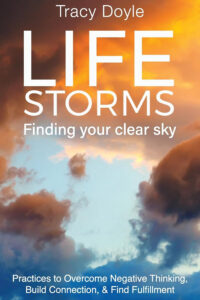
First thing I want to just unpack is what Life Storms means, because a lot of people ask that question. To me, Life Storms is nothing more than that daily churn that you feel, that frustration, that anger, and sometimes it leads you to act in a way that you really do not like. That is what a Life Storm is. It happens daily. Finding your clear sky is really about how we shift our perspective related to that inner churn.
The reason I say that is I am a person who basically struggled with emotional burnout for years and years. There was a time when I felt so isolated and alone, and I was struggling with emotional burnout, and I had no idea what it was. I grew up with a mentally ill mom. I have had some significant experiences in my life. Some are exciting, but some are actually profoundly traumatic.
Basically, as the first in my family to break free from poverty and go to college and really find my way in the world, what started to happen was it started like stress. I have this pressure, like I have to make it because I am the first to do it. I grew up in scarcity, so I have to prove myself in the world. What started to happen as time went on was this sense of overwhelm. My responsibilities increased. I am an overachiever because I do not want to fail.
I made it out of there. I am not going back. Basically, what started to happen was that with that overwhelm, I had responsibilities of taking care of my mom. I had big responsibilities at work. I then started assuming custody of my sister’s kids. I became a caretaker and, all at the same time trying to build a sustainable relationship for myself. That overwhelm became pretty deep. During this time, I believe that sacrificing myself for my family, for my job, for my relationship was what a good person looked like.
That is what defined me as being worthy of all of this stuff that I had in my life. As time progressed, what started to happen was conflict. I was in conflict. It felt like with everyone and everything. I cannot even explain it. It was like a little trigger went off. Everyone was taking me the wrong way. What I did not realize then was that my responses were actually snappy or dismissive, or perceived as arrogant. I am inside thinking, “No one understands me, and I am not heard.”
The less I felt heard, the more I would push. I would want to be heard, which then led me from conflict to emotional outburst. When you look at any data on burnout, that is the trajectory. What emotional outbursts look like was screaming to be heard inside. On the outside, what it looked like was overreactions that were not commensurate with what was really happening. Where did that take me? It took me to an island.
I was isolated and alone, and I can remember it was yesterday. I was just done fighting with everyone and everything. I am getting ready for work. I call the holidays the Bermuda Triangle because it starts with Thanksgiving. We are there for everyone. We are overdoing it. We are the host for the performing week. It has got to be pretty. It was around Christmas. It was December 21st. It was 1999. It was a cold, gray winter’s day.
As I am getting ready for work, I catch a glimpse of myself in the mirror. I just, like, eyes were hollow. My spirit was really dim. I did not even recognize myself. Inside my head, I start whispering, “I am done.” I am getting angry. “I am done taking care of my mentally ill mother. I am done being responsible for my sister’s children. I am done being stretched in every single direction at work. I am done fighting everybody and everyone.”
Where it went from there was, “It is the holidays. If I get good and drunk, I might crash the car. If I crash the car, no one will ever know I did it on purpose because I did not want to look weak.” Burnout takes us all the way through to potentially suicide. I was so disconnected because I went through with that, and I was jolted awake by someone knocking on my car window. I was a hair away from a head-on collision.
I was that close. This voice is, “Are you okay?” I am like, “What have I done? What happened?” I still get a little emotional because it was like, “How did I get so lost?” I was like, “I got out of poverty. I made it. I am a senior vice president. How did I get so lost?” The thing that happened next was that the next day, as I was really sitting with what I almost did, I realized what could have happened. It was my heart, and my head was having a fight. It was, “Tracy, look what you almost did.”
Self-Care & Seeking Help
Heart is like, “Tracy, you are still here.” That was the moment I was like, “I want to live again.” Really, where that took me was the very first lesson, which is that sacrificing oneself is not about abandoning yourself. It is about putting yourself first while you are managing everything. The first thing I had to do was give myself permission to not only get help but accept it. I got help. I go to therapy, and I get treated. I go on a journey of understanding what happened.
Sacrificing oneself is not about abandoning yourself; it’s about putting yourself first while managing everything else. Share on XMy background is in psychology and counseling. I am like, “I’ve got to figure this out.” I get the right help, and I start to get better. The reactions came back, and the conflicts came back. I am like, “What is this?” Here is what I learned. Here is what inspired the book. It was not my mother, my family, or all the circumstances in my life that broke me. It was my own thinking. I was very fortunate that I had a friend who was in a twelve-step program.
Wounds, Growth, & Self-Reflection
I started talking about how I was recognizing what was happening. She goes, “There is a tool I learned I want to show you.” She showed me this tool. As someone who studied psychology, I look at it, and I am like, “This is like Maslow and Carl Jung stuff. This is interesting. What was it?” It was just who hurt you, and who are you angry with? What did they do? How did it affect you? Abraham Maslow always talks about his needs.
If you have ever had an experience in your life, and one of those needs feels stunted. Our wounds matter because we internalize in a certain way, and we stop growing. We are living in a place of what I do not have, and we are living in a place of unhappiness. When I got to see that, I was like, “That is interesting.” It went over to “What did you do in response to that harm, that hurt, or that thing that you are angry with?”
It went into, “What more did you do? Where were you in a way?” In this case, where were you selfish? Where were you afraid? Where were you dishonest? Were we thoughtless? The word selfish, really, I have to admit, upset me. I am like, “How dare you? I do everything for everyone.” What I did was I saw Jung there, and selfishness is really nothing more than being absorbed with one’s needs, one’s feelings, one’s thoughts.
I started looking up all these variations. I call them issues. Self-pity, I was absorbed with that. Self-righteousness, I wanted to be right all the time because I got out of poverty. Self-importance, “How dare you question me? I got out of poverty.” What I realized was that my thinking really kept me stuck, and my thinking was driving, but then it was like, “What aspect of my thinking was doing this?” That is when I went a little bit deeper.
What I learned was that these things were shaped by beliefs that were developed from early life experiences that really shaped the way that I thought, the way that I acted, the way that I reacted, the way that I showed up. It was these beliefs that were driving me to this place. As we saw, it drove me to the place of almost wanting to die because I sacrificed myself without realizing I had to put myself first.
What inspired Life Storms was that journey. I have helped dozens of women professionally because here I was struggling and as I was learning how to reshape what was shaped and changing, people would say, “I know a woman who is really struggling like you with burnout.” I started mentoring women. Fast forward, and I get to a place where things are good, and I am managing things well. Four years ago, I had to uproot my life and help my mentally ill sister.
She is also disabled, like my mom, and her daughter assumed the same role I had assumed, which was being her caretaker, and my niece, unlike me, knew how to ask for help. In doing that, what I discovered was that the burnout feeling started to happen again. I was in conflict again. I was reactive again. I am like, “No, girl, we are not going back. Now we are going to turn lemons into lemonade.” I decided to pour my heart into this book and share with the world what I have learned about shifting our mindset.
It’s very powerful. What are the main themes you hope readers take away from this book?
The main thing is that you can shift and shift outcomes and relationship dynamics, no matter what is going on around you. Many of us think life has to calm down for me to change, or not react like that, or not struggle and feel exhausted and burned out. Basically, what I am hoping for people to understand is that there is a way through emotional burnout, for one, but for two, there is a way to restore connection to oneself and to regain connection back to others in your life so that they can restore that sense of fulfillment. That is really what I am hoping people get from it.
You can shift outcomes and relationship dynamics, no matter what is going on around you. Share on XYou already answered that. How did your upbringing and family dynamics influence your outlook on adversity? When I was going through this book, the challenges you faced, I thought I had challenges, “You put me to shame in bad ways.”
Resilience Amid Trauma
Let us talk about what I learned. For one, I struggled with scarcity. I was in a situation where, first, my mom was a teenager when she had me. She was not married. Her family, my grandparents, and my aunts and uncles. They were a family of nine, and my grandfather was an alcoholic. They lost everything because of it. My grandmother was rebuilding their life. At a time when women did not work, my grandmother stepped up and went to work and became an executive, ultimately in her career. She was my role model.
During that time, with addiction and alcoholism, I experienced sexual abuse. My mom, when I was seven, married a guy who was an addict and an alcoholic. She made bad choices because she was mentally ill, and no one knew that that was what she was struggling with. During that time, it was the same replay of what my grandmother went through, where he was gambling their money away, drinking their money away.
We did not have food, we did not have running water, and my mom did not know how to handle it. She would have a rage. She had bipolar disorder, and she would rage if you asked her questions. She did not know what to do. I endured physical abuse throughout that time. The thing was, I could see my mom’s struggle. The way that it shifted me in terms of adversity was that I had to rely on myself to do what needed to be done.
I became my mom’s caretaker. We did not have food. I started raising kids in the schoolyard for their lunch. I was scrappy. If you did not give me that lunch, I was just going to beat the crap out of you because I had to provide food for my two younger siblings. My mom and my stepdad had two children, and they were toddlers, and they were starving, and I was starving, and we did not have running water or electricity.
I had to do what I had to do, and I did it. What it did was give me this sense of self-reliance, and it worked to get me through that time. We experienced more trauma because, sadly, my stepfather, his bottom with his addictions, took him, I do not know what he was involved in. They say gambling and loan sharking, but he was murdered, and I found him with my mom. That was devastating. It was absolutely devastating. Coming out of that, it was a time when the parent got the mental health support, but the child was just like, “Just deal with it.”
I was alone with that. What it did for me was that I had to learn how to manage through this stuff. Where I found solace and respite through all of that, while I was in it, even when I was coming out of it, was school and achievement. In my mind, if I achieved, I would rise, and I would leave that behind. Those two thoughts, “I have to do well, I have to be number one” and self-reliance, “I can do this,” got me through that and got me through that adversity. Later in life, it turned against me because it no longer worked.
It is funny because it is like it is a survival skill. Once you get out of that scarcity, you have to get out of survival. It’s really powerful. You had an aunt and uncle, and they played a big role in your journey as far as stability. Talk to us a little bit about that.
Family Dynamics Across Generations
The way that my family dynamic was with my grandparents was the first four kids so that my mom was the oldest. The next three were like aunts and uncles because they were closer to her age. The next four were they were basically closer in my age. My youngest uncle was four years old, and my next youngest uncle was eight years old. He became, in my childhood, like my brother. He actually got out early. He got out when he was sixteen because he got my aunt pregnant.
Her parents were Italian and they were from Italy and they had immigrated to the United States. They were very old school, and they demanded that my uncle marry my aunt. Of course, he wanted to. Her family really helped my uncle get away from what we were dealing with with alcoholism. He learned a trade, and he became a skilled tradesman, and he basically started his own business.
Throughout that time, I was young. They are only eight years older than me. They became like my older siblings who taught me life. When I went to college, they recognized my struggle, and they knew I did not have my mom to rely on. They became more parental. By now, they had three kids, and they invited me to be a part of the family. It started with my aunt, sadly, having stage four cervical cancer at the age of 27.
She asked me to come help her, and I did. While I did, the dynamic was very positive, and they saw my financial struggle, and they invited me to come live with them. They were just as modest as our upbringing, which was that they had a two-bedroom apartment and three children. They invited me to move in with them, and they supported everything that I did. My aunt would call me little sister, and whenever I would doubt myself, and I couldn’t do this, she would say like, “Snap out of it, little sister, you got this.”
That stuck with me because what I learned from them was many things. I learned life skills, I learned what family meant, like a cohesive family. I learned the importance of family and sticking together when things were tough. I really learned about the importance of receiving nourishment and the importance of giving it. They had a tremendous impact on my life.
Tell us about the Aurora Method.
The Aurora Method, you heard my journey. As I was learning these things, it started with that one tool my friend showed me. What I saw was the learning I learned in college with Abraham Maslow. I saw myself stunted. I saw what my therapists were telling me. I saw the wounded child. I also saw what I call the issues. I realized how my thinking had become self-centered. I wanted to break free of that. Here is a challenge.
You go to therapy, and they work with you either on anger or trauma, and you get better. You read self-help books. “Yes, I want to apply that.” You start applying it. I did body work. I did Reiki healing. I did everything because I wanted this stuff to. We all have. I wanted to stop reacting like this, and I just cannot figure it out.
Resentment & Limiting Beliefs
The first thing that I learned as I was learning this process and what the Aurora Method became was, “I have self-knowledge. I can see it, but I want to understand how it affected me. How did my life experiences shape me?” The next thing I looked at was my patterns. I created a tool called The Turnaround. What it does is help you see what needs were stunted and what you become as a result.
Maslow says if your needs are stunted, again, you are coming from a place of what you do not have. You are in a lack. You are also coming from a place of discontentment. You are unhappy, no matter how good it is, because you cannot see what you have. It is almost like you are blinded. I love Don Miguel Ruiz. He talks about the four agreements. He talks about the Toltec term, mitote, which means you are enshrouded in fog, and you cannot see out of it.
Maslow says that when your needs are stunted, you’re operating from a place of lack—focused on what you don’t have. This creates discontentment, leaving you unhappy no matter how good things are, because you can’t see what you already have. It’s almost… Share on XThat intrigued me. As I started to see these patterns, I was like, “How does this affect me? What is doing it?” That is when I realized the word resentment is a re-feeling. My friend said to me, “Resentment comes from the French word ressentir, which means to re-feel deeply.” We would have all these conversations, “What are you re-feeling?” I go back, and I am like, “Got to figure this out.” I am looking at my patterns, and I saw some of the old wounds.
I recognized the initial beliefs that they created. That is like, “Wow.” Having done that first exercise, I am like, “What is it doing next?” It is affecting a limiting belief. “I am not good enough,” or “I am not worthy.” It is shooting to my toes and hitting me with fear. Fear can take us on a wild journey. “I am afraid of this. I am afraid of that.” I like Tony Robbins’ work. I was reading about loss, less, never. It’s very simple.
Three basic fears. It is like, “Wait, what am I afraid of losing? What am I afraid of never getting? What am I afraid of being less than or getting less than?” Where does that fear shoot in between my two ears? What does it create in terms of self-centered thinking traits? I saw those on that tool, but now I am like, “This is a reaction cascade.” Once that thinking takes over, I start acting in a certain way, all driven by this initial belief that is triggered when I re-feel something. It is not that they trigger me. It was someone who looked at me the wrong way.
Overcoming Burnout & Self-Beliefs
Someone questioned me. Someone challenged me to think differently. That old re-feel of either “I am rejected” or “nobody cares.” It just whatever I was re-filling, “I do not belong,” it triggered that initial belief. That initial belief started this whole cascade, which resulted in these reactions. Once I saw that, it was like, “How do you change that?” All the data on burnout says one thing. You have got to change your outlook.
If you are me, I would be like, “Seriously, how do I do that?” As I have all this muck that all these initial beliefs that were created, all these needs that were stunted from some of the trauma. I am like, “How do I do that?” You do hear things like practice gratitude and practice affirmation. What I was doing then was doing gratitude lists. It would help for a bit. I was taking other people’s affirmations, but they did not stick. Once I could see the trait, meaning the self-centered trait, and name it, I could think and do the opposite.
That is what I call the LifeStorm Navigator. That is one of the fundamental tools in the Aurora Method to help you develop your own personalized mindfulness program by using your own personalized affirmations, because now it is real to you. From there, what you get to see when you are practicing thinking and doing the opposite is that you are able to really see, “How did this affect other people?” Essentially, we are all wounded. Everyone’s trauma is different.

Some could be critical parents, critical teachers, rejection by friends at school, or betrayal by someone gossiping about you. That is primarily a lot of people, but how did we internalize that? For some, it is a significant trauma, like sexual abuse or physical abuse. For others, it is like a major trauma, like what I did with a murder or having a significant loss. It just cuts you right off. When you get to see it, name it, change it, you practice it, and then you look at other people and see how that affected them, and see that you were creating their storms too, because you were probably their trigger.
You can now mend and bring yourself back, not only to yourself, but also back to the people in your life that matter. I know for myself, when I said, “I felt like an island.” I was cutting myself off from everybody. “No one understands me.” Bridging yourself back is one of the fundamental outcomes of the Aurora Method because you bridge back to you, and you bridge back to the people who matter, and the people I have worked with.
Aurora Method: Reconnecting Through Mindfulness
I have seen restored marriages, restored estranged family relations improve. I have seen people who have better relationships with their managers at work. I have seen people turn into better leaders because once they are connected, there is that emotional clarity. That is the Aurora method. It does not end there because maintaining it is what is so critical. It is just a five-minute-a-day practice of basically mindfulness and conscious intention.
Not falling into those old habits. Where do we find your book, and where do we find you?
My book is on Amazon. Basically, we have four formats. Hardcover, softcover, and we have an audiobook as well as an ebook. I created the audiobook because I know that so many people are so busy and they do not have time to read. What I encourage anyone who is struggling to do is to listen. If it really resonates and you want help, I am offering an Aurora Method Academy. It is an eight-week course on my website, www.TracyDoyle.life, where I take you through the Aurora Method and teach you everything that is in the book so that you can walk through it and find your way back.
That is amazing. Thank you so much for being on.
Thanks, I really appreciate the opportunity.
Important Links
- Tracy Doyle on LinkedIn
- Tracy Doyle on Instagram
- Life Storms Finding Your Clear Sky
- www.TracyDoyle.life
About Tracy Doyle
 Author, Entrepreneur, and Creator of the Aurora Method
Tracy Doyle is a nationally recognized entrepreneur, author, and emotional wellness advocate whose life’s work bridges the worlds of business success and personal transformation. As the creator of the Aurora Method and author of Life Storms: Finding Your Clear Sky, she helps high-achieving professional women overcome burnout, reshape limiting beliefs, and reconnect with themselves and others—so they can lead their lives with calm, clarity, and confidence.
Tracy was the first in her family to graduate from college, earning a bachelor’s degree in psychology and counseling before building a groundbreaking career in the pharmaceutical industry. She founded and led a multimillion-dollar medical communications company recognized for innovation and impact—earning regional honors including the Ernst & Young Entrepreneur of the Year Award and recognition from Forbes, Entrepreneur, and Inc.
Yet behind the accolades, Tracy faced the silent struggle so many high achievers know too well—emotional burnout and disconnection. That breaking point became the catalyst for her transformation and the creation of the Aurora Method, a framework for emotional resilience and authentic living that blends mindfulness, neuroscience, and practical self-awareness tools.
Today, through her book, masterclasses, and eight-week course, Tracy empowers women to navigate life’s storms and emerge stronger, more grounded, and more fulfilled. Whether speaking to a packed auditorium or sharing her story on a podcast, she brings warmth, wit, and wisdom—inviting audiences to shift from burnout to balance, from reactivity to reflection, and from self-doubt to genuine connection.
Love the show? Subscribe, rate, review, and share!