Are you a new leader feeling overwhelmed, or a rockstar individual contributor who just got promoted and realized your old skills don’t cut it? You’re not alone. The transition to management is often described as “walking a leadership ledge”—a shaky, uncertain space where imposter syndrome is rampant and getting work done through others feels impossible.
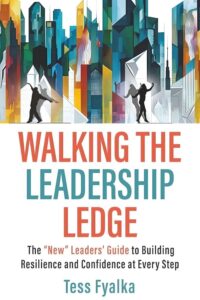
In this deep-dive interview, we sit down with Tess Fyalka, author of Walking the Leadership Ledge: The “NEW” Leader’s Guide to Building Resilience and Confidence at Every Step. Drawing on 25 years of experience, Tess cuts through the theory to deliver practical, down-to-earth strategies for navigating the “messy middle” of leadership.
We explore why being great at your job doesn’t automatically make you a great leader, how to overcome the paralyzing fear of “not having all the answers,” and the crucial shift from pursuing perfection to embracing progress. Plus, Tess reveals her secrets to successfully building a corporate workshop business—a question that stumps most experts.
If you’re ready to trade the anxiety of the leadership ledge for solid footing and sustainable success, this is a must-read.
—
Watch the episode here
Listen to the podcast here
Leadership Ledge: Tess Fyalka’s Practical Strategies For New Leaders And Corporate Workshop Success
Welcome to the show. We have one of our book marketing clients who’s going to talk about her new book, Walking the Leadership Ledge, The “NEW” Leader’s Guide to Building Resilience and Confidence at Every Step. Before we get started, I want to remind you that our monthly training is for the month of April. It will be on April 3, 2026. The speaker or trainer is Patrick Snow. He is a book developer and has a platform called Becoming a Bestselling Author.
He is one of the most amazing book developers that I get books from. The books that he develops are always really well done. He has a great editing team. He works with Tyler Tischler to get those books edited. I truly do love the work this man does. He’s also going to be talking a little bit about getting yourself booked on speaking gigs, because that is part of what he does through his training, while you’re developing the book, is getting you ready for those speaking events to promote your book.
On April 3rd, you can go over to BreakthroughEvents1.com. Our guest is Tess Fyalka. I can never say her name right, so I hope I didn’t butcher it badly. Have you recently been promoted to a new leadership role thanks to your stellar individual performance as an employee? Are you finding that the skillset that served you so well as a standout staff member is woefully inadequate for the new role of managing people and a unified team designed to fulfil a corporate objective peacefully and effectively? Health is on the way.
You’ll find all the answers you need to get started, cutting through the challenging team dynamics and managing them effectively to maximum high performance success while doing it with a minimum disruption or loss of sanity. Tess Fyalka’s new book, Walking the Leadership Ledge: The “NEW” Leader’s Guide to Building Resilience and Confidence at Every Step, pulls from her 25 years of experience in leadership, management, corporate training, and organisational development.
A sought-after speaker, Tess is one of only 247 professional leadership coaches in the United States and one of 1,100 worldwide to have earned the International Coaching Federation’s advanced certification in team coaching, the ACT-C. She’s here to offer her exceptional insights into transforming you into a superstar at leadership. I don’t know about you, but I remember vaguely, since it’s been so long ago, my days in corporate America. This was truly one of the biggest challenges to getting things done in a team environment. Stay tuned for Tess.
—
Tess, welcome to the show.
Thank you, Juliet. I am excited to be here.
I am excited to have you because you are going to answer a question that I get a lot. Before we get to that question, why did you write the book, and how did you get into what you do today?
Transition From Individual Contributor To Leader
You talk to authors all the time. I think that you probably have heard this before. For me, the book had to get out of me. It was just one of those things. I have always wanted to write a book. I was not sure what that book was going to be about. The years went on, of course, and I had not written the book. I spent thirteen years working for a management consulting company, and it was in that work that I truly fell in love with leadership development and management.
What I saw there over and over again, and was repeated over and over again when I went back into corporate America for ten years, was that time and again, evolving leaders, emerging leaders, new leaders, you decide what new is because we are new leaders throughout our careers, the same issues and the same challenges came up over and over again.
It is tragic because, as I am sure you well know and most of your audience well know, independent contributors, those folks who are rockstar team members, are put into leadership roles because they are so good at what they do as individual contributors. They are put into leadership roles, and the assumption in the organisation is going to be like, “Suzanne, who was a phenomenal member of the accounting team, when we put her into the manager position, everyone around her is going to be that amazing.”
It does not happen. In some cases, the wheels fall off the bus because it is a completely different set of competencies. There is a whole different playbook that new leaders have to learn to succeed. Really wanting to try to equip them with fundamentals, truly, but it is practical strategies. There is no theory because I am not a brilliant theorist.
There is a whole different playbook that new leaders must learn to succeed. Share on XThere are brilliant theorists out there, plenty of them with brilliant books that I would recommend. It really was intended to be very conversational, very down to earth, very, “Here is a challenge that a leader that I have worked with along the way faced,” and practical tools and strategies for how to navigate that particular challenge. It is short, it is only ten chapters.
Challenges Of Leadership Transition
When I was in corporate America, I actually had a job where I was brought in from the outside to manage, which was really difficult because people did not trust me. I was brought in on another job from the inside, which I think was even worse because then there is all that backbiting, “Why did she get it? She is not qualified. I am not going to take direction from her.” You also have to remember this was the late ‘80s, early ‘90s, when a woman in management was not highly regarded. It is not as easy as it all seems. I remember tears about, “I hate these people. I used to like these people, I got cocktails with them, and now I hate them.”
“What happened? We were such good friends.” It is an extraordinarily difficult challenge. Especially when you are like, “What do I do with this? How do I navigate this?”
I am always an action person. That was one of the things I learned is you cannot implement big changes quickly, which is why I have my own business now, because I can.
That is right. Important learning lessons there, right?
Yes. One of the questions I get all the time is how do I get corporate workshops? How do I build up that kind of business? You have very successfully done that. Any tips for those people who ask me that constantly, and I give them a blank stare?
Building Leadership Capacity Through Intentional Practices
I do not have a magic formula. I will tell you that. What I have found is, first of all, I offer workshops that appeal to corporate America. I was a corporate trainer for ten years, and I have worked in corporations for half of my career. There is that piece of it in that I do understand that piece of it. One thing that really helped me to open doors was that I created a group of women, fellow professionals, and I like to describe them as my crash test geniuses.
I experimented with them, and I would test things out with them. There were ten of them, and we still get together. I established this back in 2018, but I try to select women for this group who are from different industries. From healthcare, from manufacturing, from higher education, a really nice cross-section of women who, first of all, would learn from each other. What I did is I created a container, coaches love that term container, I am a coach, I created this space where we would get together once every couple of weeks and some weeks it would be a learning component.
Again, I would test things out with them and try new programs that I was experimenting with. Other weeks were the opportunity for a confidential space. This group of professional women could bring their challenges to the room, and they would have five minutes to share the challenge that they are facing. It would be established, “Is this something you need five minutes to vent?
You just need to get it off your chest, or is this something where you want insights from the group, and you are open to coaching? What do you want to receive from this?” It was really beneficial in that they were able to learn from each other and coach each other. I also made sure that there was a structure.
We did not just come together and chit-chat, even though that is a lot of fun, that is a great thing to do, but there was really an intention and a purpose. I would host these, and it would be from September to February, and there would be a curriculum. As I said, we might be doing a book study, or I would be experimenting with a new leadership development program, and I would be testing it out on them.
I invited them to this group, so there was no charge because they really became my board of directors. They have really supported me, and they opened doors for me. I have oftentimes thought I want to create another cohort of women like this. I have other cohorts that I work with, but that is part of the corporate training when I do that. It was an investment of time and energy, well worth it. It is now 2026, and we still get together regularly.
Now you guys have the answer to that question. It is going to take some work. We do this monthly training, and people always say, “Why do you do that?” We see people show up, and then they become clients. It is a good investment of time to get your knowledge out there as well. Onward from that. I want to know why being great at your job does not automatically translate into being great at leading people.
Key Leadership Shift: Getting Work Done Through Others + Self-Awareness & Identity Change
We touched on that at the opening. When you are great at your job, you are producing and rewarded for accuracy, speed and competence in that particular job. All of a sudden, in leadership, you have to get work done through others. Until we are all replaced with AI, we have to get work done through others, and we have to build those relationships.
Until we are all replaced by AI, we have to get work done through others and build those relationships. Share on XWe have to create the infrastructure and the culture where our team members can succeed. These things, like setting clear expectations and what success really looks like? What is high-quality output to you might be mediocre to somebody else, or vice versa. How are you having those ongoing conversations? How are you moving from peer to leader if you are internal, or how are you building that trust out of the gate if you are coming in from the outside?
You have to create a plan of action and be very intentional around those core competencies of leadership. As a leader, how am I building a team? How am I showing up with courageous authenticity in terms of I can speak to the things that some folks might want to step over or look the other way? How am I being strategic? Three big buckets there. Long answer to your question, I am not sure if I answered it.
You did, in a sense. One of the challenges I had, as a peer going to a leader, was that I worked with a group at Mattel. Do not laugh, guys. I hope nobody from Mattel is listening, but literally before our manager left, there was a whole group that would stay. Our manager would get on the elevator, and then everybody would run over to the elevator.
I kept teasing them, saying, “One day your elevator is going to hit the ground before it does.” There is that part of it, too, where you know your teammates inside and out, and you do not necessarily know if they are working or kissing rear end on it. That has to be a tough part when you are transitioning too, knowing what your teammates are doing and not doing.
That is part of creating the infrastructure. In terms of what the cadence looks like? What does the cadence of communication look like? What does the culture of communication look like? How are you setting that up as the leader, where you are having weekly check-ins and then quarterly touch bases? Yes, there are still annual performance reviews, and they do serve a purpose, but that cannot be the only time that we as leaders are talking to our team members.
It is so much of the interpersonal work, and that is where the biggest challenges lie because many folks have not developed those skills. That takes time, and that takes nurturing, and it takes experimentation and vulnerability. The other piece of it is that as the leader, you do not have all the answers.
Especially in the late ‘80s, early ‘90s, when you were stepping into leadership, that was very much the command and control twentieth-century philosophy to leadership, which worked in simpler times, particularly in the industrial age, and you would have come up through the factory floor in the manufacturing industry. By the time you got leadership, you did have all the answers because you knew how the entire line worked.
Now we are in such a state of complexity and interdependence, and the leader’s ability to acknowledge, “I do not know, I do not have all the answers.” That is a really scary place to be because our brains are wired for certainty, and certainty in this day and age, good luck. I am not even certain what season we are in right now. That acknowledgement that I do not have all the answers, and that is okay. That is one of the big fears that I see with new leaders.
I was going to ask you about that because when you are going from being that employee who is delegated to, now you are delegating, and sometimes in that delegation, the people below you do not realise that there is someone above you who is delegating as well. There is a lot of that feeling. I do not have all the answers. I cannot get all the answers, and I am caught in the middle. How do you address that?
The messy middle. It is a hard place to be. There is no “Do these five things, this five-step strategy, and that is going to take care of it all.” It is the what are the circumstances that you are dealing with? What is your scenario, your situation? It is a matter of having a game plan, and you might have to adjust that game plan. How are you creating the infrastructure again? You are going to hear me repeat myself, but the infrastructure is where you have regular dialogue.
What are your teammates doing? Where does somebody have capacity? You are overwhelmed, and is this a task or responsibility that only you can do, or is this a growth opportunity for somebody on your team? There is another part of this that is really hard for individual contributors to let go of, “If I am not doing all the work, how am I still relevant?”
They lose sight of the fact that this is the time when you are stepping into leadership, where you are connecting much more to the strategic plan. How are you translating in this place of the messy middle? What is happening up here with the strategic plan, and how is your team part of that strategic plan and connecting to that so they see the relevance in the bigger picture?
That is part of it. As you are delegating things because you are growing the future leaders in your organisation, you are also growing as a leader. I was really good as an individual contributor in this space, but I do not necessarily fully understand what is happening in finance or what is happening in distribution. How are you then learning as a leader the other pieces of the organisation’s puzzle? The other aspects of the organisation that help you bring that to your team, and you are helping to further break down the silos, where there is greater collaboration across different units and divisions.
As you delegate tasks to grow future leaders in your organization, you are also growing as a leader. Share on XThat brings me to another question here. How do you get through the progress versus perfection? That is really hard when you are delegating to someone who used to have your job, and you had a way of doing it, and it was smooth, and now that person wants to do it their way. It is hard to let go and say, “The job is getting done. It may not be the way I did it, but it is getting done.” How do you get rid of that need to control?
Self-awareness. Yes, the need to acknowledge that and recognise that. That really is a place where coaches can be so helpful to emerging leaders in terms of what the competencies are, what the tendencies are, and what the things are that served you really well. I share the story of Liam, which is one of my favourite stories and one of my favourite clients in leadership development coaching. He was one of those folks on the team that you want on your team because he got stuff done.
He was smart, and he was fast, and he was accurate. He gets put into leadership, or he becomes a manager. Now he is experienced as controlling, arrogant, and aloof. All of those things that were like, “He was like a duck on water.” You would never see him sweat. Now, where he has to build these relationships, the impression is completely different. Recognising the number one development skill for leaders is developing self-awareness. What does happen to me? How do I react? What do I feel?
What do I think? What are the assumptions that I am making when I am letting go of this? That was my baby, that maybe I even created, and now I have to hand this off, and they may not love it and nurture it the way I did. Part of it is that you are also creating a new identity for yourself, and you are still attached to that old identity of “I got that thing done really well.” Once again, I do not pretend that there is a magic formula or that you just do these three steps and everything is great.
It is a process of recognising what happens to me and also really paying attention to that tendency. Am I changing this just because this is the way I want to do it, because that is the way I did it, or does it really have to be done that way? In some cases, it has to. These processes need to be followed in this order. You have got some wiggle room over here, and that is self-awareness. I am repeating myself.
It is. By the way, that is not just in corporate America. I hired a scaling coach last July, and I heard, “Let it go.” I wanted to micromanage the situation that was going on and have it done my way. The work got done. Once I let it go, the work got done. It just was not the same procedures I would have used. Do not confine that to corporate America. What do you mean in your book by the leadership ledge?
That really is a metaphor for standing it feels like on a ledge. Back here, when you were an individual contributor, or you were in the other organisation, whatever it was, another position that you were really comfortable in, you were on solid footing. Now you step into this new position, and it feels like you are on the ledge. One misstep and you do not know if you are going to go tumbling down 10 inches or a hundred feet. It is just that very tenuous space between. It is the liminal space where you are in between the place that you knew so well and that place where you are becoming the next iteration of the leader, the professional, the team member that you are working toward.
Do you think that is why so many new leaders feel really doubtful? I think a lot of them just immediately get into it and go into imposter syndrome, “They are going to find out I do not really know what I know, or they think I know.”
Imposter Syndrome & Front-Line Leadership Reality
Yes. It is such a state of uncertainty. Again, the vast majority of them are thrown into the leadership positions, whether they are formal or they are informal, with no leadership training. Yet, it is often folks who are directly facing the customers and the clients, those are the folks who are 80% of the organisational strategy that gets done through those folks on the front lines who are the front-facing. They tend to have the least amount of leadership development and training.

Where can we find your book and you? This is really interesting. I would not limit this book to just if you work in corporate America. Take a look at it if you run an organisation of your own, because you might get some understanding of what some of your people are going through as well.
A little side note here. I was talking to a friend of mine who is a choir director, and she bought my book. She was like, “There is so much of your book that I am applying.” I am thinking, “Really? A choir director?” Yes, I guess it makes sense because we are all in leadership positions in some capacity or another.
We do. Just to backtrack on that a little bit. I even read through all of your books when I do book marketing for you guys. I could see parallels there that maybe I could have a little bit more compassion for some people in my organisation. A little bit more empathy on what is going on, that maybe, as the owner, I had not looked at that before. I think there is something in it for a lot of people.
I agree. You can find it on Amazon, and the audible just came out. I am very excited about that. You can find me on LinkedIn or on my website, Walking The Leadership Ledge. That is the name of the book. Also, my business website is Angle Coaching.
Those will all be in the show notes, including the link to her book. Tess, thank you so much for being on.
Thank you, Juliet. It was a blast, as always.
Important Links
- Tess Fyalka on LinkedIn
- Walking the Leadership Ledge, The “NEW” Leader’s Guide to Building Resilience and Confidence at Every Step
- Becoming a Bestselling Author
- Breakthrough Events1
- Walking The Leadership Ledge
- Angle Coaching
About Tess Fyalka
 Tess Fyalka (Fee-al-kuh) is an award-winning author, leadership development coach, team coach, corporate trainer, and speaker. She brings more than 25 years’ experience in leadership, management, corporate training, and organizational development.
She is the author of the recently released book Walking the Leadership Ledge; The “New” Leaders Guide to Building Resilience and Confidence at Every Step. (www.walkingtheleadershipledge.com).
The book earned early recognition generating three first place fall 2025 BookFest Awards in the Business Leadership categories of Leadership & Management, Business Communication, and Women in Business.
Tess is one of only 247 professional leadership coaches in the United States, and 1,100 worldwide, to have earned the International Coaching Federation’s Advanced Certification in Team Coaching (ACTC).
She is a 2024 Illinois Women in Leadership Athena nominee, which recognizes 10 women for professional excellence, community service, and for actively assisting women in their attainment of professional excellence and leadership skills.
Tess recently spent nearly 10 years as director of employee development and engagement for a mid-size commercial construction company where she built their leadership development, coaching, and corporate training infrastructure. She was instrumental in leading the organization to earn the Apex Training Top 100 recognition in 2022 and 2023, which is awarded to only 100 organizations worldwide.
Prior to that she was an independent consultant and worked for 14 years with a management consulting firm, which specialized in helping small businesses develop their management systems.
She has authored or ghost-written more than 2,000 articles, white papers, blogs, and chapters in books on topics related to management and leadership.
She is the owner of Angle Coaching & Communication, LLC (www.anglecoaching.com), a private coaching and consulting practice specializing in leadership development and team effectiveness.
Her passion is helping leaders at all levels develop the essential core competencies to lead successfully and equipping organizational teams with the tools they need cut through challenging team dynamics and achieve their full potential.
Love the show? Subscribe, rate, review, and share!
- superbrandpublishing.com
- Promote, Profit, Publish on YouTube
- Follow Juliet on LinkedIn
- Take the Quiz!