

Parenting may look different across cultures, but the values that build strong families are universal. In this episode, Dr. Christine Silverstein — behavioral health RN, peak performance coach, Master Neuroplastician, and inductee into the Columbia University Nursing Hall of Fame — shares what she learned translating her award-winning book, Wrestling Through Adversity, into Arabic and how that journey revealed powerful truths about family, resilience, and raising capable children worldwide. From competitive youth sports and “everybody gets a trophy” culture to the deep reverence for family she encountered in the Middle East, Christine explores how mindful toughness, neuroplasticity, and mind-body healing can help parents guide children through adversity anywhere. This is a thoughtful, practical conversation for parents, coaches, and educators who want to raise resilient kids grounded in timeless values.
—
Watch the episode here
Listen to the podcast here
Parenting Differences Across Cultures And Christine Silverstein’s Universal Values For Families
“Reflecting On A Remarkable Journey”
Welcome to the show. It is our launch day for The Perfect Reader Playbook. You can go over and buy it on Amazon, or you can go to our website, PerfectReaderPlaybook.com. Over there, you can also buy the book, but you can also grab the first three modules of our course. We are giving them away for free. We want people to understand the value of this before they commit to buying the whole program. PerfectReaderPlaybook.com is also available on Amazon.
For those of you who do not know what is going on with that, watch our episode from last week. Gary MacDermid and I, who is an AI ace and really a great program developer, have been working on this for almost a year now, I think. We have something that several businesses have purchased. We have got a lot of partners on this. Go check it out. It might be just what you need to connect with more of your readers and, if you have a business, more of your readers and more clients.
Our guest is really unique. Christine Silverstein has been a client of mine for several years now. Her first book came out in 2023, and she decided to get it converted to Arabic. Translated. We have released it in Arabic. I will talk about more in the interview. It was one of the most difficult projects I have ever been involved with because the book opens on the other side. Everything is backwards from the way Americans read. Thank God for her husband, who has been reading the Jewish books forever. He has thoroughly understood how all of that works. He has been doing it forever, and so I am really excited about this.
Dr. Christine Silverstein is a peak performance coach, behavioral health RN, and clinical hypnosis expert who assists clients of all ages to achieve their best performances in areas of health and wellness, academics, athletics, business, and performance arts. She is an inductee into the Nursing Hall of Fame at Columbia University for her extraordinary contribution to nursing care globally and was recently awarded the title of Master Neuroplastician by the NPN Institute of Applied and Organizational Neurosciences.
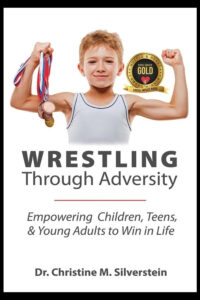
As a researcher, historian, and keynote speaker, Dr. Silverstein has represented her works on coaching and on the history of psychiatry, psychiatric nursing, and nursing science in peer-reviewed journals at professional conferences, workshops, and on local stages. In her award-winning book, Wrestling Through Adversity, Empowering Children, Teens, and Young Adults to Win in Life, she shares her personal and professional case stories and teaches her powerful mind-body techniques to promote mental health, overcome trauma, become resilient, and win in life. That is the exact book that we just translated into Arabic. Stay tuned for Christine.
—
Christine, welcome to the show. Again, you look so beautiful.
Thank you.
I mentioned in the intro that we just put together this Arabic version of Wrestling Through Adversity, your award-winning book. How hard was this journey for everybody?
It was quite a journey as I look back and say, “I do not know how I made it through, but it started really right after I published my book in English.” I was in Italy, and I had met this man who was Israeli but was living in the United States, and he was a pilot. Just a couple of days before they had the war in Israel and Hamas, this pilot was going there, and he was probably recruited for it when he went back to his country.
I often thought of that because I had realized that Arabic would be a very important language. At any rate, I had planned on translating it into Arabic when I was in Egypt in 2023, but at the same time, I did not know how challenging it was. Maybe I would have thought twice about it. It worked out at the end now.
I was on a panel last night, and we were talking about how important this is. Many people right now are trying to translate their books with AI. You guys went the native speaker route and then supplemented with AI. Is that correct?
Yes. I wanted it to be translated by a native speaker. As a matter of fact, I had two translators that I worked with. One for the first half and then another one after that. I just thought that that would be important because, using AI, you do not always get the translation that you want. Even in English, it is this idea that you believe what it says in the chat box, and you still have to do your research. Being that the Arabic language is so challenging because they only have three vowels, versus in English we have more, they have to substitute words and write in different words, but it still makes sense at the end, but you have to check it.
The only way I could know if it was correct would be to use AI just to check it, so that I could understand it in English and make sure, because my book has a lot of metaphors and imagery, and I just wanted it to be correct. That is what I did. I used both, but the translation is from two translators who were tremendous help to me and wrote in their beautiful language to describe the metaphors and the poetry, even at the end of the book.
Didn’t you have a problem with the poetry? There was something in the translation that was not working right away, as I recall.
It was challenging because of the metaphors. They would have to come up with something in Arabic that meant the same thing, but metaphors are challenging for people who speak English to understand. I have spent most of my life explaining them because I think in metaphors and images. That is the way I know my world. That is something I have been doing since I was a young child. I would ask my dad questions, and he would not understand what I was saying. I had to figure out how to explain it to people, and that is what I did in my book.
Let us talk a little bit about the marketing around the book because this is not like normal book marketing. We have to target particular countries and particular regions of the United States. You actually do not speak Arabic.
No, I do not speak a word even to this day, but I have been working on this book for a year and a half.
It has been a little bit different journey than the first time with your book. I just want to mention that for the English-speaking book, she has won two awards, and recently a third one.
For parenting and family. That is important for people to know that this is for everybody, every day people. You can learn what to do to help yourself, and you do not need to be a rocket scientist or have a PhD to do it.

Let us talk a little bit about what is in the book. I know we did an interview a couple of years ago, but I feel like even though there are different problems in 2026 than there were in 2023.
Global Conflicts Impacting Youth
Yes, many different problems, but some of the same, like the Ukraine war still going on. One editor I had told me, “Why are you writing about that? It is going to be over in a couple of months,” and that was in 2022. Some are still there. We have more conflict, and we also have disruption around the world, in the United States, but also in foreign countries.
That is one of the reasons why I wrote the book in English, because children, young adults, and also, of course, teenagers. I could not stand looking at what we’re doing to our young people and making them feel like they are worthless and making them feel like there is something wrong with them. They’re young people, and they need to learn how to grow up to be responsible adults.
Who better to teach them but their parents, coaches, teachers, and people who should know better about helping children to grow? Now in Arabic, I hope that this affects people in the Middle East to the point where they can start using these same techniques, mindful toughness techniques that I developed years ago, and begin to understand what they can do to help themselves and then also to help their children.
You also work with athletes and academic kids as well to get through blocks. Can you talk a little bit about that?
“29 Years In Performance Coaching”
Yes, I work in these areas of health and wellness, academics, athletics, business, and performing arts. I have been doing that for 29 years at my office at the Summit Center for Ideal Performance. I started off working first with my family because my children were teenagers and they were having all kinds of challenges years ago in athletics, also in school, and the challenges with friends and social challenges.
I started learning what to do when they were young and then implementing that somewhat when they were growing up, so that they could achieve success. My children were athletes, and also they were also very gifted in many ways. I wanted them to reach their potential, but I could not do that unless I knew what to do for myself. It was all based on what I had learned when I was a young woman trying to have a baby after I first got married.
I had four miscarriages. It was very discouraging to me to be called a habitual aborter and to be told that I would never have a baby to hold in my arms unless I took a really toxic drug, DES, that could cause cancer in my children. I threw the prescription in the garbage, and I just worked with myself using meditation and also self-hypnosis, which helped me through. I was able to have four healthy children some years down the road, which I am very proud of.
Let’s talk about athletics. I feel like it has changed. Your kids are probably a little younger than I, but it used to be that a kid could walk on the tennis team or the volleyball team. These days it is so competitive with all of the club sports out there. My daughter experienced this. We played soccer year-round between club, premier, and high school, and it has just gotten so competitive.
On the other hand, there is this culture of everybody-gets-a-trophy for their self-esteem. The conflict of the two is really tough sometimes because these everybody-get-a-trophy kids do not realize how hard those other kids on those teams are working. We literally used to have dinner at 8:00 in the evening between football and soccer and all of those things, and then the kids would stay up until midnight studying. The pressure these days is outrageous.
Yes, it is. I think that is partly because of how the parents are looking at it. That has always been the case. When I was younger, we used to play on the street, and Jeff, my husband, used to play with his friends with a stickball. He did not even have a bat. I guess they could not afford one. The idea is that you have to be supportive of your children and be where they are. Also, I had this experience when my daughter was graduating from high school.
You have to be supportive of your children and be where they are. Share on XThis really makes that picture of what you’re talking about, where everybody gets an award. We had three valedictorians at her graduation. Why? It’s because their grade point average was just a little bit apart from one another. They gave it to all three. I had to sit through three addresses at the graduation. I thought to myself then, because I was a peak performance coach at that time, “Would they give the award to other swimmers besides Michael Phelps when he won the gold medal?” Would they say, “There are three first places for the gold medal?”
They would never do that. That is partly because of the parents and how they’re approaching it, and I think that says it all in that situation. Yes, we need to support them, be where they are, put ourselves in their shoes, and also direct and guide them to be the best they were born to be. Winning sometimes is not just getting the gold medal.
I watched this one time, this cross-country race in the snow in the Olympics, and there was this person who won from Norway. They were celebrating with his colleagues, but then the same winner went to the finish line to greet the last person who came over the finish line, exhausted. He fell down exhausted, but there was the winner supporting him. I thought that was so beautiful. It says it all about what it means to be a winner.
“Sportsmanship And Changing Times”
What comes to mind is figure skating, where the young man, I think he was from Canada, the Japanese flag was not as it should have been, and he went and lifted it up behind the Japanese young man who was actually the winner, so he could be proud of his flag. Parenting has changed a lot. I grew up in a rural area of California, Paso Robles, and we used to play on this road called Hospital Hill. My kids and I were out walking on it, and I was telling them, like, “We used to build forts down there,” and I was telling them what we used to do, and they’re like, “Let us go do that.”
I was like, “No, there are ticks and snakes down there. You cannot go do that.” I thought, “I must have been really fearless as a child, but I would not let my children go and do that the way we used to back in the 60s and 70s.” Tell us about your goals with the translation to Arabic. What are your hopes for what this can do for this community? They do parent a little differently than the United States, and they have a little bit different religious beliefs, but I feel like the values in the book are universal.
They are universal, and I know that because I could see that from the way the translators worked and how they picked up that the family was important. They made flowery statements about my parents and my grandparents honoring family, and it was just totally different from what it is in this country, especially now when we take away Medicare or take away benefits from older people. I noticed a difference, and it was pure and beautiful with the words that they used.
“Mindset For Healing Trauma”
When we think of the Middle East, we might think just of turmoil or war and people harming each other, but that is not the case, I do not believe. There are really wonderful people I can reach out to and say, “This is how you can help your children, and it is right here in your own language so that you can understand it even better,” for those who do not speak English. My hope is that it can be used to help people to heal from trauma.
We certainly have enough of that in the Middle East. Also, to heal from wounds because I do work with people to help them with my program, Operation Heal, to overcome surgeries and overcome traumas like that. There are ways that you can do that using the power of your mind, along with, of course, physicians and medical help and supervision. Setting up your mind to heal is very important, and it has been for me.
Setting up your mind to heal is very important. Share on XAs I said, I had four babies after I was told I was infertile, and it was not solvable unless I took this medicine that was going to give my children and me cancer later on. I just threw it in the garbage and rejected it. I said to myself, “There must be a way I can do this.” I went back to those years later, and I use these practices every day, even now in my life.
They are very simple, where you can relax into the zone and help yourself to heal. See yourself healing in your own mind’s eye and work towards that. I have done that many times for myself. I have had many surgeries in my life. Four Caesarean sections where the anesthesia did not work. That was a challenge for me.
I look back, and really, those were the roots of my programs because I had experienced it myself, and I wanted to help other people to do the same. I have a background in medical-surgical nursing. When I was 22, I was the nurse manager of a 38-bed hospital unit, and I learned a lot there. Also, I worked in the visiting nurse service in the community, helping people to become healthy. I have that background pretty much all my life since I was sixteen when I entered nursing school. It is a very solid background.
Wait a minute. How old were you?
I was sixteen when I went to nursing school.
Were you a child prodigy?
Looking back, I must have been. It was very interesting. I graduated from high school at sixteen, and I did not think anything of it. I applied to this nursing school in Brooklyn. It took me forever to get there on a snowy day, and it was slush, and I got all filled with slush all over my clothing. A truck was coming around the corner, and I went to this interview, and this director went through the whole interview.
I look like a drowned rat because of the mud all over. She got to the end of the interview, and she said, “Wait a minute. You’re only sixteen. How come you want to come here? You have to be eighteen to come here.” I thought to myself, “That is weird.” I thought a moment, and I said to her, “I guess I am smart.” I got into the school.
No humble, just smart. Coming from California, I have to tell you, the first time I went to New York City with advertising, not knowing about snow, I bought this beautiful light wool cream-colored coat. By the end of my journey on a snowy New York morning, it was brown at the bottom. I learned a lesson the hard way about New York snow.
Yes, and it is not forgiving. I remember going into the bathroom before my interview, washing my legs and washing my hat because it was white, and then picking myself up and saying, “I am ready.” She tells me I am not old enough to go to school. I said, “That is nonsense,” to myself.
Did you get in?
Yes, I did.
Even though I was sixteen.
“Overcoming Challenges With Guidance”
I graduated, and I got a scholarship and everything. I was very fortunate. There was a little angel on my shoulder helping me through the interview and also through the challenging times. I wrote about some of them in my book, actually, when I went to psychiatric nursing at a mental institution, and when I was in the operating room trying to help patients there, and I did not know what to do to help the doctor. There are stories in my book about it.
You just got a new certification. Tell us about that because that is the wave of the future. People are learning more and more about the brain.
Yes, it is very interesting because I always loved anatomy and physiology when I was studying at sixteen. I got the highest grade in my class, and I remember studying at night. The only place I could go was sitting in the bathtub because they made you turn out the lights, and in the bathroom, the lights were always on. I used to put my pillow in the bathtub and study anatomy and physiology there. I got this really high grade, but I loved the anatomy and physiology of the brain.
It was my favorite topic. One time, I was in Manhattan with my friend, and these sailors were interested in taking us out to lunch, the ones that we met at the dock. My mother did not know about this for sure. I told her I was going to the library in Manhattan. I ended up in this restaurant. It was a Spanish or Italian restaurant, and calf brains were on the menu, and I thought, “I’ll order that. I had never had that before.”
Really?
Yes. This sailor thought I was a little weird because I started dissecting the calf’s brain on my plate. I was in lab heaven there, dissecting it. He said, “Are you going to eat it?” and I said, “No.” I smelled the formaldehyde in my mind. I do not think I ate very much of it. That was the beginning of me. I incorporated these ideas into my work very early on, like when I work with teenagers and the teen brain, and I kept up with the research.
I have this program, Winning Ways for Teens, where I look at how teenagers’ brains develop and why they are the way they are, and how you can really encourage them to learn and grow because their brains are expanding in linkages, not in size. Therefore, you can teach them metaphors, you can teach them imagery, and how to get in the zone. It is very easy. They love it. They tell me, the ones who work with me and win awards, they tell me, “Why didn’t anybody ever show me this before?”
Teenagers’ brains are expanding in linkages, not in size. Share on XYour new certificate is in neuroplasticity, right?
Yes. I am a Master Neuroplastician, and I earned that award by going through an exam with this organization. It is an organizational neuroscience institute, and I joined it because I know that they’re really working on gaining more knowledge. Since the 21st century, we have been learning a lot more, although in my research. I wrote about it in my book in the chapter Practice in the Institutional Wall. I wrote about how we did not know very much way back when I was a student.
Adolph Meyer: Neuroplasticity Pioneer
Even up to 2000, we were just beginning to learn about neuroplasticity. Although there was a doctor that I wrote about, Dr. Adolf Meyer, way back in the beginning of the twentieth century. He had that concept, and I call him the father of neuroplasticity, even though they did not have the instruments to measure it like they do today. He was an advocate of it. He even got in trouble. People did not believe him, and they discredited him.
Caring For Stroke Patients
We have neuroplasticity, and your brain can recover even after a stroke, which they did not know for the most part of the twentieth century. This is a fairly new concept. I remember learning as a student nurse that your brain can develop. One of my first patients when I was young had a stroke the night before, and I remember going into his room.
I was supposed to take care of him for the morning, and I was petrified because he was in the bed, they did not have an ICU, and somebody put a tray at the foot of his bed, and he was drooling. He was paralyzed. He could not speak, and I was supposed to take care of him, which I managed somehow with my limited knowledge. I took care of many people who had strokes, and I worked in neurology at one point at NYU and learned a lot there as well.
I knew this information long ago, but of course, we’re adding to it almost every day. It seems somebody is doing a study to help us through these challenges. I believe that just knowing the anatomy and physiology of the brain does not show you how to work with people to help them to recover from a stroke or something like that. It helps to know so you can set up your programs accordingly, and I find it very helpful.

That’s great. Christine, thank you so much. This has been very enlightening. For those of you who are watching this, we have the link to both books in the show notes. If you are an Arabic speaker and you’re looking for the book on Amazon in Arabic, just put Christine Silverstein into the search bar, and it will come up. Unfortunately, the way that it is entered in there, unless you can write in Arabic, which most of our keyboards do not have, the way you’re going to find the Arabic version is Christine Silverstein. Christine, thank you so much, and we will talk to you soon.
Thank you for the interview.
Important Links
- Dr. Christine Silverstein
- The Perfect Reader Playbook
- Perfect Reader Playbook
- Wrestling Through Adversity – English version
- Wrestling Through Adversity – Arabic version
About Dr. Christine Silverstein
Dr. Christine M. Silverstein is a peak performance coach, behavioral health RN, and clinical hypnosis expert who assists clients of all ages to achieve their best performances in areas of health and wellness, academics, athletics, business, and performance arts. She is an inductee into the Nursing Hall of Fame at Columbia University for her extraordinary contribution to nursing care globally and was recently awarded the title of Master Neuroplastician by the npnInstitute of Applied and Organizational Neuroscience.
As a researcher, historian, and keynote speaker, Dr. Silverstein has presented her works on coaching and on the history of psychiatry, psychiatric nursing, and nursing science in peer-reviewed journals, at professional conferences, workshops, and on local stages. In her award-winning book: Wrestling Through Adversity: Empowering Children, Teens, & Young Adults to Win in Life, she shares her personal and professional case stories and teaches her powerful Mind-Body techniques to promote mental health, overcome trauma, become resilient, and win in life.
Love the show? Subscribe, rate, review, and share!
Join the Promote, Profit, Publish Community today:
- superbrandpublishing.com
- Promote, Profit, Publish on YouTube
- Follow Juliet on LinkedIn
- Take the Quiz!