Ready to make 2026 your best publishing and book marketing year yet? In this essential guide, host Juliet Clark dives deep into the hottest trends shaping the publishing world. From the explosion of genre-bending fiction (think Sci-Fi Mystery and Romantic City!) and the ongoing demand for authentic, human-written content, to leveraging cutting-edge AI tools for editing and marketing—we’ve got your roadmap. Discover the genres set to dominate, tech trends you can’t ignore, and monetization strategies that work! If you’re an author looking to lead, connect with readers, and reach your publishing goals, you need to hear this now. Tune in and get your 2026 strategy locked down!
—
Watch the episode here
Listen to the podcast here
Essential Book Marketing And Genre Insights For Indie Authors In 2026
Genre-Blending Reads on AI Mystery
Welcome to Promote Profit Publish. I’m your host, Juliet Clark. Happy New Year. Before we get started, I want to talk a little bit about our event on the 9th of January. It’s our first training of 2026. As usual, it’s always free. We have a seven-figure coach. She is going to be talking to us about a new chapter, a new year, and mindset secrets for authors who want to lead. We’re going to be leading this off the new year, kicking it off with mindset, which is super important. If you want to reach your goals, you have to have those goals made, and you have to get yourself in the mindset to accomplish them.
In this episode, I’m going to talk about what’s hot in 2026 and what you should be looking for as an author. I’m going to go over a little bit of it with you. Hopefully, you pay attention, do some research, and figure out how you’re going to proceed in 2026. First of all, let’s jump into popular themes and genres for 2026. There are a lot of genre-blending books that are going on right now. Those are books that blend different genres together. It might be sci-fi and mystery. I actually read a book that was sci-fi and a mystery. Fantasy and historical fiction, blending some of that fantasy into a time and space that may be real. All of those are expected to do well.
I read what I think is a little blend of genres in Michael Connelly’s book that talks about AI and the implications of AI. It was a little bit of a mystery because it was a lawyer mystery. There were some profound concepts in there. At first, I thought, “Is this fiction?” I’m not going to give away what it is. “Did he just make this up?” There’s actually a lawsuit that is going on right now that pertains to the same topic. Teenagers, avatars, and how these can control and mind-bend teenagers to be able to do things that they might not ordinarily do, like committing suicide or hurting someone else, or getting lost in the fantasy world of a girlfriend who is on screen, who isn’t there and isn’t real.
There are a lot of things like that going on that are these blended genres. If you haven’t read Michael Connelly’s new book, put it on your list because it’s an eye-opener about AI and how AI can be skewed in a particular direction and by us. There’s that. Another thing we’re seeing a lot of is romance and what I will call romancetasy. It’s a blend of fantasy and romance. These genres are consistently bestsellers, with romance plus fantasy being a particularly strong sub-genre. Think about that if you’re a romance writer or a fantasy writer. How can you blend the two of them together?
That is the amazing thing about the self-publishing world. It has opened so many genres to us. The traditional publishers no longer own the mass media products like they used to. There are so many new genres and so many new places we can go when we are writing and using our imagination. Thrillers and suspense are always good sellers, both psychological and other thriller genres. They are pretty much popular year-round. I should probably own stock in Audible because I download about 7 to 10 books a month, and most of those are mystery novels.
If you want to reach your goals, you need to define them clearly and put yourself in the mindset to accomplish them. Share on XI love mystery novels, but don’t worry, I get some educational stuff in there and some political stuff. I do mix it up, but I’m really partial. Part of that is what I’m going to talk about next, which is escapism. When I’m out running and listening to a book, it’s an escape. It’s an escape from all the chaos that’s going on in the world. Escapism is big in 2026, too. Fantasy and science fiction are both very strong genres. Their stories, you can immerse yourself in.
One of my big things on the weekend is, as I’m running errands, I’ll go to the gym, I’ll run, and I’m running errands. I’ve got earphones in the whole day, listening to a book as I’m running around, and getting my chores done. That’s why I have so many books. I can literally listen to a book a day on a weekend, a lot of times.
Authenticity. The reason I’m going to mention that is I’ve seen so much, for lack of a better word, crap lately. That is, they are AI-written books. As the AI books and the rise of AI come along, people are looking for more authenticity. They want those writers who write without it. That doesn’t mean that you can’t write the book, and then go back and be able to look at it in a sense of adding some touches, editing, or doing something like that, because I do. When I write a book or when I write something, I run it back through AI and maybe sometimes ask it for some rewrites or something like that. That’s perfectly legit, but nobody wants books written by AI.
AI, Copyrights & Creative Challenges
That brings me to a new point. We are actually having an event in February, our free training. I’m going to talk about copyrights and piracy in the age of AI. The copyright office will not copyright some books because it will not copyright anything that’s AI. If you look around, at all, in the world, when you upload the AI books, you actually have to tell the platform if they are AI-driven or not. It is very important to think about how you’re using AI in this process.
I’ve also used a few AI writing programs. I tested them out. I can tell you, I’m not happy with them at all because they take my stories off in a different direction, and I can’t get them on track with my imagination, and where I want them to go. They may be good for writing, but they have a mind of their own when they take your story in a particular direction. The outlines could do a better job there.
AI’s Role in Content Creation
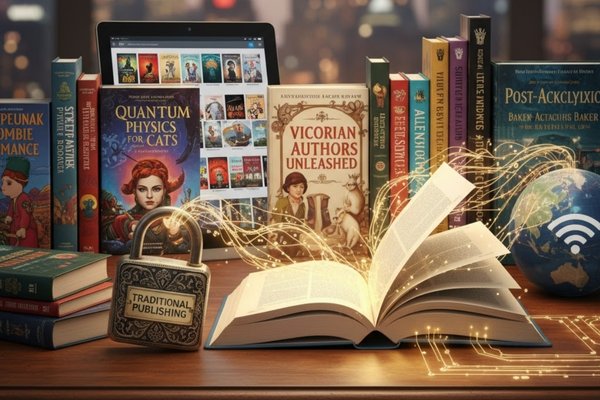
Let’s talk about the attack of technology trends. Obviously, we’re talking about AI. AI integration tools are being used in the publishing process for editing, formatting, and marketing. Some publishers are using them for automation and content enhancement. We do that a lot. I mentioned that I will write an article on a topic. I usually run it through AI. I tell them how I want that to be presented in that process, and then I go back and I put my own personal touches on it. It can save you a lot of time. I do that with a lot of our content.
Also, the automation. When you’re looking at your automation and your marketing programs, a lot of that, I can go inside of GoHighLevel. If I don’t like where the funnel is going, I can ask for AI to assist me and guide me in a different direction. There are a lot of programs we use technology-wise. Our YouTube videos, we put them through Castmagic. Our shorts, we put them through Opus. There are a lot of programs out there that can do a fabulous job for you in the marketing realm with your books that you may not even be aware of, and it’s streamlined.
Once I get in it and I’ve used it and I love it, I hand it off to my assistant. I say, “This is what we’re going to do.” My assistants, I have three of them, are shocked at how that looks and what time savers they are. The other thing is your formatters. Adobe has an AI component to it as well. It makes formatting a little bit easier. It makes cover design a little bit easier. It’s a lot of those elements that we used to do.
One of the big things I do is I love and I am a devotee of Perplexity and the Comet Browser. They’re probably the most amazing tools I’ve ever seen. I threw ChatGPT away a long time ago. I’m not a big fan of Grok. I hate Gemini. I have strong feelings about Gemini, but I love Perplexity and Comet because they will actually give you the citation. When I write an article and I go back and look at the citations, I can see, “Does this have a bias in any way? Are these good citations? Is this good information on the internet, or is it bad information?” As we all know, the internet is not always right.
Digital expansion. We are seeing more digital books. Ebooks continue to grow. A lot of the reason ebooks are growing is because, between the price of paper and the distributor fees for hardcover and softcover books, they are a more economical way to read a lot of books. Personally, I’m not into that. I’m more into Audible because that’s the way I learn. I am partially an auditory learner, so I like that. That is my segue into the next.
Audio Books: Growing Market Insights
The audio market is growing rapidly. A lot of people are finding that they can listen to a book while they’re working in the garage. They can listen to the book at the gym. They can listen to the book in the car. I could imagine if I still lived in Los Angeles and was spending an hour to two hours a day on the freeway, I would love audio or Audible. That’s where I listen to books. Keep that in mind, too, as part of your publishing packages.
We love Twin Flames Studios, especially because they give you a producer and you can record your own book, which, by the way, you should. If you are an influencer, if you’re a podcaster, if you have a YouTube channel, or if you already have your voice out there, then people are going to expect to hear your book in your voice. Be sure you budget for that as well.
Many years ago, I interviewed Dorie Clark, and I listened to her first book that didn’t have her voice in it before the interview. I listened to her second book, which she did read. It was like night and day. I asked her about it because there’s nothing like when you, the passionate author, read your own work. No voice-over person can radiate that authentic passion the way you did when you wrote the book.
There's nothing like hearing a passionate author read their own work. No voice-over artist can radiate the same authentic passion you had when you wrote the book. Share on XThat doesn’t mean everybody has to do it. Some people don’t have the voice for it. I will admit that I had a difficult time when I read a book because the breathwork that these actors have, I don’t have it. You could hear huffing. I’ve had people who have sent me versions where they’ve tried to record their own, and I can hear their huffing, too. It’s not for everybody. You may not have the voice. You may not have the breath, but I will tell you, once you try it, you will gain a big respect for voiceover artists and people who read these books as actors.
The blockchain. Some publishers are embracing and exploring the blockchain, mostly in the royalty area, for more efficient payments to authors. We haven’t done that. We are still doing them the way we’ve always done them. At some point, that may be the next thing where we enhance our systems and do it that way. I’m sure it’ll be much easier because it’s the thing I dread every month. We still do them in a reconciliatory way. We have to reconcile not only the statements every month, but also what the year-to-date looks like. Are we paying people the right thing? At some point, I’ve got to step into this century and do it the right way.
Monetizing Books Beyond Royalties
Indie authors. Let’s talk a little bit about author and market dynamics. Indie authors have seen significant increases in earnings. Now more than ever, they have more ways to monetize their work. One of the things we do very well with our authors is that we work mostly with nonfiction. We do have a couple of fiction authors, but their books are fiction related to what they do for a living, which is very helpful. That’s where the monetization comes in. When we bring a new client in the door, we ask, “What do you have planned as the big ticket item for this?” You’re never going to make a living, or probably won’t make a living, more than likely, off of the $1 to $3 royalties from the books.
Are you using this as a nurture tool to bring people to a big-ticket item? Is that coaching? Is it a product, a service, or a consultation? You have to look at that and make sure that even if you go to a traditional publisher or a hybrid publisher that you retain your rights. We did run into something a couple of years ago where the company that our author was thinking about working with showed us the contract, and they got 30% of any programs, products, and services that this author sold.
We were like, “Do not sign that contract.” I literally said to her, “How much do you make a year off that?” She said, “Approximately $240,000.” I was like, “Do you want to give these people $80,000 of your money, just because you published a book with them, which was already your intellectual property?” The answer was a resounding, “No, we don’t.”
Direct-to-consumer strategies. This is where I talk about ditching the 55% if you work with a publisher, and even when you work on Amazon. On Amazon, you have to give Amazon 30% for hybrid books. I don’t know what it is for traditional, because they take a cut as well. You have to give the distributors 55% of your retail price. It means, right away, if it’s a $19.99 book or $20, we’re giving them $11, and then the book has to be printed.
Finding ways to ditch that 55% is always a good idea to keep more money in your pocket. We have a lot of people who are doing it. I’ll give you a couple of examples. We dropship books to events for authors, so they have signings. If they’re a keynote speaker, they can sell them right there. A lot of them have Venmo or QR codes, so the person in front of them just pays, and then they get the book signed.
We have some other things where our people will go out to corporate entities. One of our clients is a cybersecurity influencer, and he does this very well. He gets other cybersecurity companies that he coaches for that he dropships. He gets the company to buy 100 to 200 books, and we haven’t shipped them there. He goes out and he does a talk, and he picks up more business. There are ways that you can do this effectively, where you don’t have to give away that 55%. We had an author who, if you bought the book from their website, they cut the price and pay for shipping. Because of that 55%, they had that room in there because they ordered the quantity of books, and they were able to do that.
“Super Brand Audience Accelerator”
Think about all these ways that you can integrate these items into your 2026 schedule, how you can up your game in 2026, and do this in a way that maybe you’ve never thought of before. People are coming out with out-of-the-box ideas. I’ve told you guys before that we have our Superbrand Audience Accelerator. I ran that for an event that I’m going to be speaking at. I’m actually recording this in November, but I ran all the marketing for her off of that. We’re planning on selling books, products, and services at the event. She has a very high-ticket offering.
Keep that in mind. That Superbrand Audience Accelerator is good for your business marketing plan, your book marketing plan, and event marketing. There are a lot of different uses for it, and I loved when it gave her the hooks. They were probably the ten best hooks I’d ever seen. I know she’s going to use that top one, which I won’t share because I don’t want to get in the way of marketing. Keep all these ideas in mind because there’s so much out there that’s running on AI that’s going to streamline your life and make your marketing and reader connection much easier. All right, you guys, see you next time. Thank you.
Important Links
- GoHighLevel
- Castmagic
- Opus
- Perplexity
- Comet Browser
- Twin Flames Studios
- Superbrand Audience Accelerator
Love the show? Subscribe, rate, review, and share!
- superbrandpublishing.com
- Promote, Profit, Publish on YouTube
- Follow Juliet on LinkedIn
- Take the Quiz!