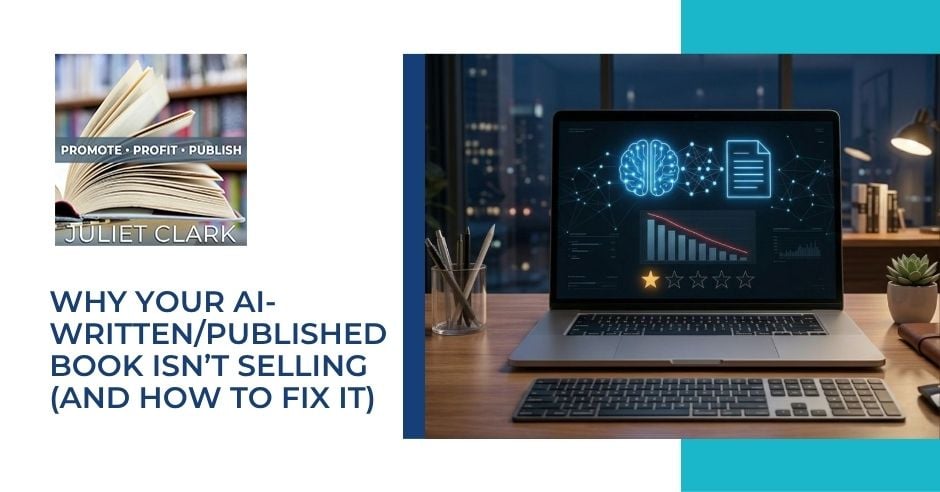
Are you struggling to get traction with a self-published manuscript? AI book marketing strategies often promise instant success, but many authors find themselves stuck with finished books that simply aren’t selling. Host Juliet Clark breaks down the “lottery” mindset that keeps new authors from building real audiences and explores why technology is no substitute for a solid business plan. In this episode, she pulls back the curtain on common publishing pitfalls—from the copyright risks associated with AI to the critical need for a professional brand guide. Learn how to stop treating your book like a hobby and start managing it like the professional asset it truly is. Whether you are writing fiction or non-fiction, discover how to leverage AI tools correctly while maintaining creative control and building a sustainable author platform.
—
Watch the episode here
Listen to the podcast here
Why Your AI-Written/Published Book Isn’t Selling (And How To Fix It)
Why Your AI-Written Book Isn’t Selling: Avoiding Common Pitfalls
Welcome to the show. In this episode, it’s just me, but I’m going to be speaking about some things I’m seeing in the marketplace that you all need to be aware of. There are some big problems out there and people think they’re saving money but they’re not. Before we get started, I want to remind you in a couple days, our July free event is coming up and it’s, Your Funnel Isn’t Broken, It is Empty. Rebecca Bertoldi who I work with on GoHighLevel on, was seeing a lot of people build funnels but they have no idea how to drive traffic.
The key to getting your author platform up and running before your book comes out is learning how to drive traffic for leads, buy books, and buy whatever you have. You can sign up for that event. It’s on July 10th, 9:00 AM Mountain Time at BreakthroughEvents3.com. I hope to see all of you there. I’m going to unveil some tools that I found that have been a big help. One of them I’ve been doing on a regular basis. The very first one I did, I ended up with fifteen new people on my list. It’s something that works for particular genres of books. That’s just one of the tips I’m going to be sharing with you folks.
What I wanted to talk about is that more and more people are learning that they can publish their books with AI. There’s nothing wrong with that. If you think you’re saving money by doing that, then more power to you but some big problems have risen from it. I probably have two to three people a week that other authors have referred to me that are just stuck. They’re like, “I don’t know how to sell the book. I self-published the book. Now, I don’t know what to do with it.” That brings up some big problems. We’re staying in the industry.
If you think you're saving money by using AI to write your book, more power to you, but some big problems have risen from it. Share on XI’ve mentioned in the past, AI is great for some things. It’s not great for other things. That’s what we’re going to talk about, why your book isn’t selling in the AI era and how to fix it. The AI goal brush has a lot of false promises attached. Authors are bringing me those finished books. The first thing I’m going to ask you when you bring me that book is, what is your goal behind writing this book? What is your long game that you hope to achieve with this? The common thread I get are two things. The first one is, “Why didn’t anybody else ever ask me this?” That’s the first thing.
They’re a little bit stunned with the, “I don’t know.” The other thing is, they treated their book like a lottery. What do I mean by that? I mean that they thought, “I wrote the book. I published the book. It’s there. Leads, come on in.” It doesn’t work like that. Again, it’s that Kevin Costner thing. If I build it, they will come. They’re not coming. That’s the first thing I want to tell you about. AI book writing tools and publishing a week and promises are exploding all over the place. I will tell you that I see them everywhere. They’re in my inbox there.
I’m challenging a lot of the things that come into my inbox now because there are so many scams out there. You look at some of these AI book publishing platforms. It’s like, “You can pay so much a month and it’s $5000. You pay over a year.” I’m going to tell you what I see as a publisher and why I always get paid up front. Once people who haven’t built a platform published that book and they’re on a payment plan. You don’t get any more money from them. It’s a silly concept, unless you can fulfill the promises from the book.
These have been exploding about 30% in the marketplace. Are people offering those things? I have never encountered an AI written book that is worth a darn. You may think it is, but when you send it off to an editor, they’re going to tell you, “This stinks. There’s no personality in it.” There’s so much non-personal. All of the major platforms where you load are going to ask you if you use AI to write your book. Let me put a little line there as well because I do use AI. Not to write the book but I do put it in for grammar and spelling. I write mystery novels, so I will put it in and say, “Do you see holes in my plot? What needs to be fixed?”

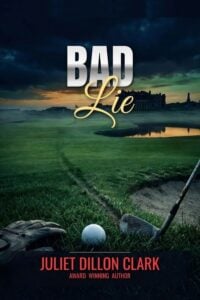
I use it on that basis, but I always have an outline I’m working from. The work is mine. I do research with AI if I don’t know a particular area. I know my editor on one of my books, Bad Lie, said, “You’ve got all these little tags in here.” The tags were from research or places where I asked questions. I rewrote a little bit for me to give me an example. Those got left hand. He just took them out. They didn’t impact the book there. I want to let that writing your book on a weekend and with AI is not going to make this a bestseller. It’s not going to bring you lace.
Protecting Your Intellectual Property: AI Copyrights & The Anthropic Lawsuit
I’m going to walk through seven or eight specific ideas that I’m getting over and over and why they’re not working. Hopefully, you can glean something out of this if you’re someone who wants to use AI to self-publish. Maybe there’s some fixes you can make. The first thing is AI copyrights and why throwing your manuscript into a bot is risky. Many of you probably heard about the big entropic lawsuit. I just mentioned to you that I will throw it into AI when I’m done with a manuscript and I will ask it questions. How was the plot? What is the core promise here? What has been fulfilled? I’ll ask you to give me feedback.
AI is great for some things, but it's not a substitute for your unique voice. The work needs to be yours. Share on XHere’s what I don’t do. I don’t put my book in there and ask for things like that until my copyright is filed and my LCCN is filed as well. Now, you don’t necessarily need an LCCN, but it will tell you with the anthropic lawsuit, the people who got money, had both of them filed. What that did is when the whole settlement came down, those self-published authors who were part of it got no money. They didn’t get money because those two things were linked together. What I have done in my own publishing company is, every single author gets an LCCN now. That means a Library of Congress Control Number.
The reason that I do that is because I want my authors fully covered. If you hire someone to publish your book, great. Ask them to do both. If they say they won’t, walk away. I will tell you and I’m not going to name names here. I do a lot of book marketing for people as well as that platform building. One of the things that I see over and over is publishers like myself will put a copyright blurb on the copyright page but there’s no copyright filed. That is a big problem in today’s world because AI can steal your work.
For a few years, I couldn’t even work with them because there was nothing I could do. Two or three authors who went through AI and when they went to publish their book, they found that their book had already been published. There was nothing that they could do because they didn’t file that copyright. Make sure that you have both of those things done. I’ll connect the dots for you here. Big AI companies are getting sued for using books for training data. Why are you giving your data to them unpublished and unregistered manuscript tools to create policies for them?
This is why it’s so important. You could easily find your book or your research or whatever you’ve done in somebody else’s book because they used AI to write theirs as well and you didn’t cover your material. Again, I want to cover the edges here. I’m talking about writing your book. AI is fabulous for getting your metadata, brainstorming, and ad copy. I need to push back on ad copy a little bit because I’m going to tell you a little secret. I tried to use AI to run ads. They were the worst. No clicks. I hear from other authors as well that in Amazon, the ads are not working. They’re wasting money. It is good for some of those things.
If you’re using it as a repository for your proprietary in IT or the grunt work. It’s okay, but remember that humans retain creative control and rights strategy. I would highly recommend, 1) You have a copyright. 2) You find out how to file an LCCN, if you’re self-published. Sometimes they don’t take self-published books. That was going to be a problem for some people because they don’t want to process all of this. With the publication, it increased. Always register your copyright. Have a minimum of a near-final version before you register. That means you don’t dump it into AI. Don’t give it to an editor. Don’t let beta readers do anything with it. Don’t do anything until your copyright is filed. End of story.
Nobody gets to see it. Except maybe your immediate family or someone you know that’s not going to steal it. Read the terms of service on the AI platform you work. You want explicit language that your data is not used to train public models. I’m working with a company and the first thing they told me out of the gate was they have a volt. That is another thing you can ask as well. They have a volt that protects what’s going on. Next thing on here. I went through the LCCN or the Library of Congress. That professional copyright page, when I open it up and look at your book. I can tell right away you’re self-published.
I have someone. I went in. I looked at his first page and I said, “You self-published, didn’t you?” He said, “Why would you say that?” It’s like he had no idea and most of you don’t. That copyright page matters. It matters because it’s a professional page that signals that the book is real. It’s a legally protected product. It’s not a hobby file. It includes the copyright notice, edition info, and the publisher imprint. If that publisher is you, that’s fine. Make up a company or if you’re a business. use your business company. The ISBNs and the cataloging information, which is what the LCCN is.
The LCCN basics are the control number that is a unique ID that helps libraries, vendors catalog your book and track your book as well. When I say that LCCN is important, if you’re self-published authors, you probably notice that you’re not getting in the library. You take your book over to the library and they look and say you’re not eligible. That’s why. It’s because you don’t have an LCCN. You’re not eligible to be in their files. That’s how they catalog their books. That’s the first thing. It is free in the US. You apply for it in pre-publication and include it on the copyright page.
It tells people that you professionally did this book in a way that it’s cataloged. It increases the chances that libraries will consider taking it in. Here’s the problem I see. If you don’t have any LCCNs, the copyright pages are incomplete and messy. I saw one. Somebody sent me a book and they said, “My granddaughter did this. Isn’t it amazing?” The book was amazing. It was a children’s book. The illustrations were fantastic. I don’t think I’ve seen anything as beautiful since the Winnie the Pooh books. The way the scrolling was and the colors and everything. The problem was as I opened up her copyright page. She had no ISBNs on there. She had no control number.
This is the thing. If you don’t treat your book like a catalog pride product, why would the market take it seriously? I want you to think about that. She is coming on as a client and we are going to fix all of those things that when I opened the book, I can see it’s not professional. She hasn’t hit the publish button yet, which is nice. It is a color. It is going through InGrowth. I probably will recommend that she pull it from InGrowth because InGrowth’s pricing with the 55% in that premium color makes those books almost impossible to sell because they’re too high price.
Mastering Book Positioning: The Power Of Back Cover Copy And Design
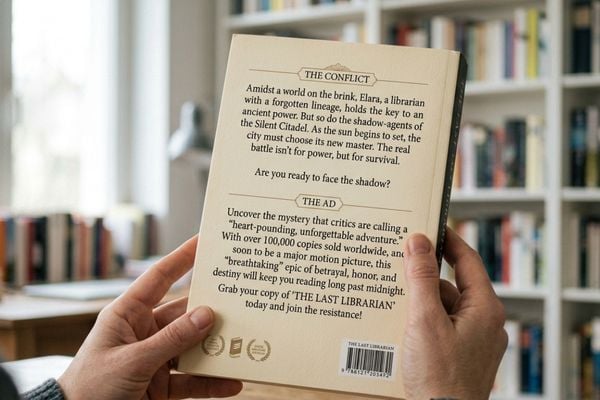
I probably will suggest that she does an Amazon imprint the first time and then build that audience until she can get an agent and get this bookshop because it is truly worthy of shopping to a publishing house. Number four, weak back copy cover. This is the product description for your book. It’s not a summary. It’s a book that’s driven at. It is an ad for your book. Many respectable market resources recommend 140 to 200 words. Beyond 200 words, the attention drops off and the conversations fall. Here are the things I see. Rambling synopsis instead of a conflict-driven book. No sense of state. No genre. No promise. What are the states of reading this book? Why should I read this book? No clear, “This is for readers who love X positioning.”
Even though it’s one of the best ways to help authors identify that they want to read this book. Here’s a simple formula you can use. Open with the book core props or conflict. Whatever that is. Quickly establish who, where, when, and when punch the what’s at risk. Close with the selling paragraph that either, if you love X, you’ll enjoy Y. I know when I put these in consistently, when I try to have AI help me with this, they always refer to my books. If you love Ton Hannah French and the way she depicts the Irish landscape or the Irish small towns, you will love why. Which is my book because most of mine are around small towns.
I’ve never had a book where that happened. I never read Hannah French but now I have and I agree. It’s also useful at the time after you got your copyright and you put this into AI to ask the AI what other authors are like. I did that with mine and I got a list of about twenty. I have to tell you. The top five on the list are people that I read regularly. I was shocked but then I had to sit back and wonder how much of that was influenced by what I listened to in their books. I even found two new authors that I’ve been exploring lately. They will probably be my summer author project because when I find a book I like or an author I like, I read everything. I found some new people doing that as well.
Number five, poor cover design and an AI-saturated thumbnail economy. You’re probably seeing a lot out there. I had two people at the same time. She was doing her books on PowerPoint with AI. I have no idea how she did that, but that’s how she formatted and designed them. The other one was using Canva and it was all design-oriented. It was all AI illustration. You’re not going to get a copyright on that book. They will copyright the words. They will not copyright those illustrations. You need to make sure that you do your own illustrations if you want to copyright.
If you got to the level where you build an audience, no publishers are going to take it when they are AI-generated. The eBook and digital reading market continues to grow. Which is where most readers are seeing your cover for the first time. It’s a tiny little thumbnail on a retail side or the thumb. At the same time, the AI tools have made it easy to pump out covers, but not necessarily good covers I must say. You see a lot that are generic. They’re low contrast. They’re unreadable on the thumbnail designs and they scream at your product.
Here’s the first thing I would recommend if you’re going to be the author of multiple books. Have a brand guide developed first. That way, if you insist on going in and having those designed by AI, AI has a guide to work from so that all of your books are branded the same way. If you go over to JulietDillonClark.com, the website for my fiction. You will see that they are a pattern to the designs. That’s because I did a brand guide first. I knew what I wanted and I knew how I wanted them to look. What a good cover must do if you’re insisting you’re going to do this.
It must be legible in thumbnail size. It must signal the genre immediately. If you go look at the Fortune Teller’s Daughter, there’s Malibu, the fortune teller, the broken ball and there are lights. There are police car lights in the background flashing off of the ring. You know immediately this is crime or murder or mystery or something like that. Your book must reflect the genre instantly. You must match the visual expectation of the reader. Not your personal preferences. What does the reader want? See why it’s important to have that author platform built? You need to do this for the reader and not for yourself.
I knew that going into this brand guide. We can continue to expand the brand guide so that a reader can automatically identify my books by sight. Here’s how AI is misused here. Authors rely on AI prompts instead of hiring someone who understands topography, genre conventions, and series branding. All of those things I talked about. Your start is not, “I wrote the book. I have a cover.” Since you’re going to build a platform, your very first is, what does my brand guide look like? What is my brand Bible going to tell people about these books?
Building A Sustainable Author Platform: Beyond The Book Launch
The result might be a pretty cover that you get from AI. It may be off genre if you don’t have that built. Visually noisy. It’s killing the click-through in a crowded search because, remember, everybody else has a cover. They’re probably by AI as well, as I’m seeing that. Number six, no platform, no audience caption. This is perhaps the biggest thing. AI is an amazing tool for platform building. It is, in a sense because it can tell you exactly that brand guide, what your genre and how you get to those people. More successful authors are building direct-to-consumer ecosystems, newsletters, stores, and membership-style communities.
They want to own their reader relationships instead of relying on retailers only. That is a smart strategy because more than likely, you’re not going to get those retailers to pick up that book. If you’re over on Amazon, you are fighting in a crowded market. If you don’t have an agent, chances are you’re not going to get into that bookstore. Quite frankly, I told my office authors, the bookstore destination is not where you want to be. The reason why is returns. Returns will kick your butt monetarily and authors don’t understand that. When they put it in for bookstores on InGrowth, if you happen to get picked up, you may get a big bill from InGrowth in the end because you just got chargebacks. They are very expensive.
Authors don’t understand this, which is again why I say you need to understand the industry before you go forward. Audience development is now considered the top trend that you need to follow. Authors are creating more serial content. They’re creating micro communities. There are a lot of great programs out there that can help you with this. I mentioned in the beginning of the episode that I’m going to be hosting the webinar about Your Book Funnel Isn’t Broken. It’s Empty. Some things you can do to pipe that up.
Here’s my message about this part. Authors show up when the book is fetched. They show up on my calendar. They’re ready to go. They have the money to publish. That’s fantastic. They have no email list. They have no clear reader home base. We’re doing a lot of websites for these readers. They have no plan about how they’re going to capture that audience. One thing that you don’t realize until you get here to me is that, that audience when people buy on Barnes and Noble, Amazon, Books-A-Million, Apple, or wherever your book is sold. You don’t know who bought your book. That’s a problem.
If you are going to be a serial writer, you need that audience to know you, to be in your funnel. That’s why funnel building and platform building takes so long. It’s not just so you can have an engaged audience when you launch. It’s so that you can keep engaging. What are you going to give away free on your website? How are you going to drive traffic there? What programs are you going to use to build that email list? How are you going to build it? We’re doing the broken funnel’s webinar because you all have funnels or you think you have funnels but you don’t know how to drive traffic. It’s as simple as that.
If you can’t drive traffic by the time you launch, chances are you’re not going to have readers on there. That book is just one node in a larger ecosystem that you need to learn how to build if you want to generate book attention. I have a client that told me he has spent well over $200,000 getting his five books out there. He spent it on marketing without the platform building. We are now going back and building that platform because he would like the non-fiction side to be a business with his wife when she retires. We are building that, but we are also building the fiction side. Be aware. You can spend a lot of money on a lot of nothing if you don’t build a platform.
You can spend a lot of money on a lot of nothing if you don't build a platform. Share on XAuthor Strategy: Setting Clear Goals For Your Book Business
Number seven, no goals. No strategies. I want to sell books. Goals define your platform and how it is built. I have a client who came on board. Her goal is she wants to be a speaker. She has a topic that she speaks on that she’d like to build a business around build on her personal experience. We are going to build her platform differently than someone who says, “I already have a business. I don’t speak. I want a lead gen.” Those are two different things.
If you are a fiction author, it’s a completely different way to build that platform. Quite frankly, it can be a little bit slower because you don’t have a full business behind it. That goes back to where I tell you that you’re treating your book like it’s the lottery and not a full-blown business asset. Define your goals in advance. Not write your book and then define your goals. I want this book to feed my high-ticket coaching or consulting. You build up a platform built on lead capture, credibility, assets, and possibly speaking. If you want a long-term fiction career, you need an email, consistent release schedule, series branding, reader groups, and ad experiments.
You can see there is a completely different funnel that needs to be built there. I will tell you with my non-fiction. I have a book that I’m giving away for free. I’m going to give it away at the end of this episode and on the book funnel talk coming up. I rarely give away a book on non-fiction. On fiction, I have a free book I give away. As you move through your series, you can go back and give an old book from your backlist away. That’s what I’m doing. I rewrote a book from my 2010 backlist and that’s being given away as the three gifts. I’m building my list.
I also mentioned that I just added fifteen new people to my list with another thing I’m going to talk about in the books following them. Here’s what I’m seeing. Authors get on a calendar and they can’t answer, how many copies would make this successful in one year? What are the other revenue streams that I want to support with this book? What is my plan for book 2, book 3, and book 4? Without those answers, you cannot prioritize the platform tasks, your budgets or your timelines. Everything feels random.
I’m going to say this on an even bigger basis. I would say 90% of you come to me, you don’t have an adequate budget for what you want to build. That’s one of the things you need to find out in advance with that guide. How are you going to spend that money? Where are you going to spend that money? Do you have that money? You can’t rely on book sales to get that. Think about that in a very deep way.
Navigating The Modern Book Market: Understanding Strategy And Sales
Zero understanding. Number eight, how the book business works. Generative AI has dramatically increased the number of books entering the market. That means that book prices are going down and that may influence the way you publish your book. If you’re over on InGrowth and your book is $29.99 and your competitive books are published differently, and they are $14.99. People aren’t going to buy your book. You have to keep that pressure in the back of your mind. The reason I’m dissing InGrowth here is it’s per page count. That’s the price of your book or the cost of your book, wholesale.
It’s 55% to retailers. You’ve just taken a huge chunk of your book right out of the process of making money with it. It’s harder to make money. What is your plan as a non-fiction author? What are you going to leave them to sell to bring that money in? I don’t make a lot of money on my books because I have to keep that retail cost down. Where I make my money is when you come into my world and build a platform or publish or book marketing. I have that bigger ticket plan out there. It’s baked into the plan. At the same time, authors are going about different platforms to get out of the retail space.
I’m working with Domingo Silvas on his Praxis AI. That is a place where you will be able to sell your book. They take a lesser percentage. You sell your book over there. They have AI that can talk to your book. Those are the kinds of things we’re seeing cropping up more and more where you don’t have to go to an Amazon. You don’t have to go to Barnes and Noble. You don’t have to use InGrowth anymore to be able to get that book up someplace for sale. That is a big plus. It’s direct sales. There are IT pricing strategies you can do like film, TV, podcast or merchandise.
Think about your IT first, your intellectual property. How do you want it used? I have authors in the non-fiction space who are doing limited series podcasts to support the book sales. It’s pieces from the book in that podcast where somebody can go and listen to ten podcasts. We have one in English. That same book was released in Arabic. It’s being developed in Arabic now. What are the things that you can point to if you want to go to get a speaking gig? Go over and consume not only my book but listen to the pieces of my book that impact you.
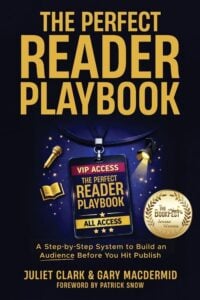
The other thing that I see so much of is that you guys don’t understand basic models, trade, hybrid, self, and direct-to-reader. Director to reader is a newer thing that you need to explore if you want to make more money with your books. I have the Perfect Reader Playbook over on that new Praxis AI. I can make more money over there, which is not really my concern. I went in on the founder level because my book cover will be on all of their marketing now, which is a big plus for me. How retailers and algorithms surface your books? How does this whole thing work? Amazon changed.
If you read my episodes regularly, you know Amazon changed everything in 2025. That’s maybe why your book is not getting the visibility that it used to. Do you want to use retailers? I personally would like to avoid retailers because they take a big chunk of the profits there. The role of metadata, pricing, and categories is super important. How copyrights, ISBNs, LCCN support. We went over that earlier in this. How can you position yourself as the guide in this area? The authors who survived the AI thread are the ones who treat their book like an asset and a business. Not a lottery ticket.
The authors who survive the AI threat are the ones who treat their book like an asset and a business, not a lottery ticket. Share on XUsing AI Effectively: Strategic Market Research And Quality Control
To use AI well as an author, it’s not all bloom and doom. You can use market research to brainstorm comparable titles, keywords, audience-paying points, or who your book is most liked. That can be a plus on Amazon ads. I ran ads for a couple where I took that list of 25 authors that my book is liked. When somebody went to an ad for that author, my ad came up. When they went over to look at one of them, my book came up as an ad for that. For marketing assets, your blurbs, your ad copy, your social content, your drafts, and your email ideas. Get all that refined way before that book comes out and start building that audience.
Structural health is great for outlining, checklists, and talking to the page. I talked to mine. I want a particular contract. How do I get this? How do I structure the book to get the attention of this? I’ve done that. I’m writing another book. The ones who are after Bad Lie. We have structured it to get a particular contract. Remember that you always maintain the final editorial control and you still need an editor. I cannot tell you this enough. I stack Bad Lie repeatedly through AI. Where is my grammar? Where is my spelling? Catch all the places that are wrong with this. Guess what? The editors still found a bunch of stuff that needed correcting.
AI is not always right. It can be used once that copyright is filed to be put through and correct a lot of the things. A lot of the grammar and spelling. I used my Microsoft, too, and the editor still found a lot of errors. Don’t skip that editing piece. It is very important. If you want to find out more about building the platform, building that audience, and what you need to do. I’m giving away the Perfect Reader Playbook for free.
AI is not always right. Use it to correct grammar and spelling once your copyright is filed, but don't skip the professional editing piece. It is very important. Share on XYou can go over to PRPFree.com and download your free copy and get that going. That is the most important first step. Even for that branding guide of getting out there and figuring out how you’re going to do, promote, layer your marketing, build that funnel, build that website, and build everything you need to do this well. That stands for Perfect Reader Playbook if you’re not writing this down. I hope to see you at the event to learn more about how to drive traffic to your funnel.
Important Links
- Juliet Dillon Clark
- BreakthroughEvents3.com
- Bad Lie
- InGrowth
- Praxis
- Perfect Reader Playbook
- PRPFree.com
Love the show? Subscribe, rate, review, and share!
- superbrandpublishing.com
- Promote, Profit, Publish on YouTube
- Follow Juliet on LinkedIn
- Take the Quiz!