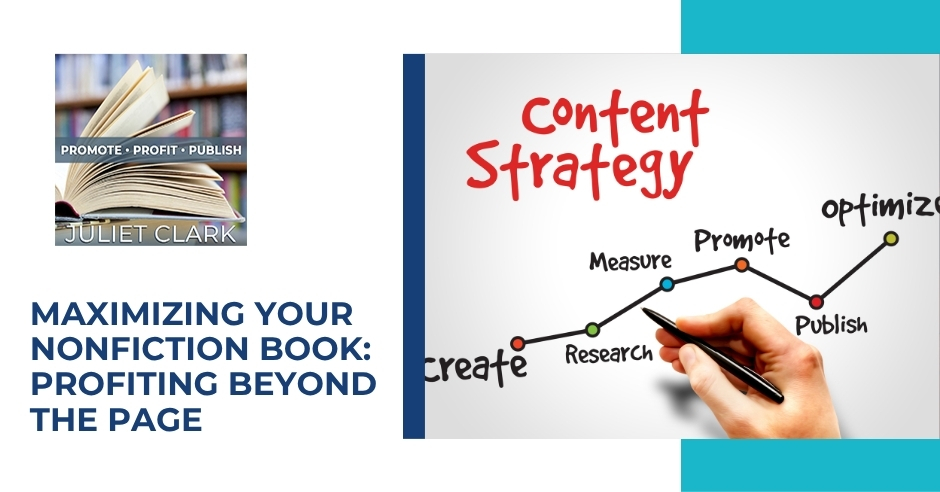
The work of an author does not end with writing and publishing a book – it goes even beyond that. Juliet Clark explores everything you must do to maximize your nonfiction book with Melody Ann Owen. She talks about the three types of potential book buyers and the effective marketing strategies to connect with them where they are. She breaks down how and when to treat your work as a product or a business asset, as well as the most valuable ways authors can use AI tools. Melody also emphasizes the importance of building your own platform, your so-called “castle,” instead of relying on existing social media sites where the rules and regulations are out of your control.
—
Watch the episode here
Listen to the podcast here
Maximizing Your Nonfiction Book: Profiting Beyond The Page With Melody Ann Owen
We have another guest who’s having a big event coming up in Las Vegas in November 2025. Stay tuned for that. Before we get started, I want to remind you about our free monthly trainings. October’s event is going to be with Rebecca Bertoldi on October 3rd, 2025. We’re going to talk about author funnels. I know you guys don’t like to build marketing on this, but all of you need it to build your audience. Part of your author platform is building those funnels that will attract readers when you launch your book and beyond that, when you launch products and services.
Secondly, our other is, again, with Rebecca Bertoldi. We have a monthly Go High Level training that we do. Rebecca does that every month. If you’re not somebody who’s using Go High Level, you should be. It is the best all-in-one program out there. We love doing these trainings. I happen to know that when you’re an author, sometimes, tech is not in your wheelhouse, so it’s great to learn the system. It’s easy to learn, and it has so many amazing features. That will be on October 16th, 2026. This time, we’re going to go over surveys, forms, and quizzes. You can sign up for that at GHLMonthly.com. For the October training, you can sign up for that at BAMagTraining.com. I hope to see all of you guys there.
Our guest is Melody Owen, the Founder of Author Nation and a non-fiction book strategist for experts, speakers, and entrepreneurs who want their book to grow their business. She is a competitor, but there’s room for all of us in this field. Melody has worked with doctors, Olympians, and industry leaders to help them translate their complex knowledge into books that are not just readable, but profitable.
She specializes in turning books into business assets that attract the right clients at the right stages of readiness. In this conversation, she’s breaking down the three types of buyers your book could be speaking to, which are DIY, DIW, and DIF, and how to expand your offers to meet them where they are. If you’re a published book, but you’re not seeing the ROI you expected, this episode is for you. Stay tuned for Melody.
‐‐‐
Developmental Editing And Book Strategy
Melody, welcome to the show. It’s great to have you.
Thank you so much. I’m thrilled to be here.
Tell us a little bit about Author Nation. You have this huge event every year. I’d love to know what inspired you to create that.
I love this question because there are two Author Nations. That’s the other Author Nation. This is so funny. I started Author Nation years ago. The people who run the Author Nation event were under a different name, entirely. I was Author Nation, and then they decided to change their name. For some reason, they chose Author Nation. They didn’t realize there were two of us, so I messaged them and said, “Guess what?” We chitchat, and we’re good friends, but it’s funny.
I’m slightly different from they are. I don’t know who has been around longer, but I’ve been around longer under the name Author Nation. They were under a different name previously. I’ve heard fabulous things about them. If you’re out there and you’re thinking of going to a conference, go to that one. It is spectacular. They changed their name to my name for some reason. I’m not sure why.
My Author Nation, on the other hand, is a little different. We are a community specifically for nonfiction authors. We offer support from the very seed of an idea, right through to writing the book, publishing the book, promoting the book, and profiting from the book. I don’t do everything. I partner with people. My talent lies in getting that seed of an idea into that edited book and then helping them tie that into the promotion.
I’m a developmental editor. The most important thing people need to do is, before they write the book, understand why they’re doing it, who they’re helping, how they’re helping them, and how they’re going to promote and profit from the book before they write a single word. I don’t do publishing. I send people to you and other people.
When it’s time to publish, I partner with people. You’re a fabulous partner for that. We can then both work with people to get that promotion and the profitability going based on what their goals were at the beginning. That’s what Author Nation does. I work with big thinkers. I work with medical professionals, data scientists, college professors, and entrepreneurs. There are lots of people who have these fabulous ideas, and they’re like, “How do I put that all into one book?” That’s what I do.
That can be difficult sometimes because they wanted everything in that book, and you can only handle so much when you’re reading. That brings me to my next question. We were talking a little bit about marketing. People buy the book. I know that from my own Author Success Handbook. If you don’t limit the amount of what needs to be executed in that book, people will read it, but they won’t do anything.
Effective DIY Learning Strategies
That brings you into the next segment, which is courses. You’re giving them a reason to take the course as well. Can you talk a little bit about that marketing trail? People don’t plan. I find authors don’t plan in advance when they get to me. They don’t have anything built. None of that platform is built, and that’s a recipe for disaster.
That’s why I like to partner with you, because that way, you are focusing on what you do well. You need them to come to you with something that’s workable in the first place. That’s not just a book. That’s what I want my career, my business, and my brand to look like as an author. People always want to put everything in the book. What I say to that is, “You don’t need to write a 1,000-page book. That’s not what we’re looking for. Try for 30,000, maybe up to 60,000 depending on the topic words. What you want to do is figure out what the right content for the book is. To know that, you need to know what will come next.”
I like to divide people into three. The Do-It-Yourselfers, the Do-It-With-Yous, and the Do-It-For-Yous. Your book is for the Do-It-Yourselfers. There is a whole group of people who will never buy anything but a book. Unfortunately, a lot of Do-It-Yourselfers will read 100 books, have all this knowledge, and do nothing. There’s another group of Do-It-Yourselfers who will read one book at a time. They’ll understand the actions they need to take, execute those actions, and then go to the next book.
As an author, you want to be careful what you are putting in the book. You don’t want to put so much in there that nobody can act on it, but you do want to give them enough to get going as well. If you have a Do-It-Yourselfer or one of your readers is a Do-It-Yourselfer, they’re not going to move on to something else, although they may want the workbook. They may want the templates. They may want other pieces that help them do it by themselves.
You do not want to put so much in your book that nobody can act on it. Share on XWhat you want for them is a Do-It-Yourself kit, which is not just the book, but it’s the book, workbook, template, checklist, and all of that. If they love the book, love the actions, and want it for themselves, they can go to your website and get the Do-It-Yourself kit. You don’t call it that, but that’s what it is. They get that kit, and you can bundle all of this into one. They bought, let’s say, an ebook at $9.99. They’re so excited. They see that they can go to your website and buy something else. They buy that for $97. That’s all they’re ever going to do. They’re going to run with it, they’re going to do it, and they’re going to be excited about it. Those are your Do-It-Yourselfers.
Can I stop that for a minute? I always tell my people I love the story brand model, where they have to opt in for it. You’re list-building and giving them the tools. The reality is probably 90% of those people will read the book, put it down, and never execute. I hate that thing for everybody. Not everybody who buys the book will execute on what’s in it. In fact, most people won’t. The toolkit is a cool idea. You can do that with the opt-in as well.
You can have one piece of the toolkit, which is the opt-in. You develop a relationship. As you go, there can be other products and services that they can buy that will help them do it themselves. I use that model. As an example, I have a store. The things that you can get in my community by subscription are also sold one-off in the store. If you don’t want everything, that’s fine. There’s this. You can do that piece yourself. That way, I’m satisfying the needs of the Do-It-Yourselfers.
If you’re someone like me, when I go buy that Do-It-Yourselfer, because I am motivated to do it, I will buy one course at a time, because I set aside an hour each morning to work on the course. You have to break it up, too. It is remembering that your audience is probably not able to sit in front of a computer all day for eight hours. They’ve got clients. They’ve got a business to run. You have to break it down in a way that it is consumable. I would be one of those people who buy it one at a time and then work on it one at a time.
Balancing Independence And Collaboration
There might also be areas in your life where you’re not a Do-It-Yourselfer. It might be that, “I’ll do it myself for marketing and technology, but I’m not cleaning my own house,” for example.
You read my mind.
We are all Do-It-Yourselfers. We are all Do-It-Withers. We are all Do-It-For-Mes. We fall into each category in different parts of our lives. I’m a very self-motivated person. I can do a lot of Do-It-Yourself, but when I started my YouTube channel, I hired somebody to do it with me because I’ve seen a lot of people stumble through their YouTube channels, not get what they want quickly, and not understand what goals are good.
I hired someone to do it with me, even though I am often a Do-It-Yourselfer. It depends on the topic. It depends on the person. There are so many pieces, which is why I say to authors, “Have something for everyone at each level. You can’t serve everyone, but you’re going to serve a lot more people if you understand the needs of each type of person who is coming to you.”

I love that model because when you do that with you, you learn it. I feel like for those people who have the Done-For-You, if something goes wrong with that Done-For-You, their sense is, “I’m going to throw the baby out with the bath water. We have to start from scratch.” They didn’t do the Done-With-You and understand how to fix and how to adjust. Marketing is a guess a lot of times. It’s trial and error. If you don’t know how to fix it, you may be in big trouble spending too much money.
Do-It-ForYou is great for house cleaning, but it wouldn’t be good for YouTube. As a business owner, you need to understand YouTube enough that even if somebody else is doing it for you, you can make good decisions. You’re not relying on someone who may or may not understand your business fully. It can be more of a Do-It–With-You in that case.
Avoid VA Mismanagement Costs
The other reason I encourage my clients to do the Do-It-With-You is that if you are delegating to a VA, and I had this happen at the beginning of my business, I would get these huge bills. I sat down one day, and I did it myself. I went back to her and said, “Why does it take me 1 hour and it takes you 5 hours every week? You are the expert here. It should be flip-flopped.” I got rid of her. That’s another reason you should because you may be spending money that you don’t need to spend because your person is inefficient. You haven’t been delegating properly because you don’t know exactly what to delegate.
For everyone who works with me, I do training videos. I have training videos and checklists for everyone who works with me. They track what they do, and they track how long it takes them. When someone new comes on, I know, “They’re not efficient. Can the training help them?” We’re side-swiping a little bit. Let’s talk about Do-It-With because I think Do-It-With is probably the most important piece.
A lot of people are saying, “I want to write the book and be done with it.” A lot of people say, “I want to write the book and get that one-on-one client, the Do–It-For-You.” Often, you get fewer of those. For the Do-It-With You, some people should be doing it with you because they’re learning as they go. You have masterminds. You have group coaching. You have courses that have the instructor available. A course with no instructor available is what I would call a Do-It-Yourself course. A course with an instructor available would be a Do-It-With-You course.
You have this subset of things that are Do-It-With-You. Usually, those are group coaching and courses with instructor availability. I have a community. For my clients, it is very much a Do-It-With-You. We have writing sessions every Monday. I do trainings every month. There’s a section in the community for Q&A. Somebody decides to put a 30-second spiel about their book in the community. Others can come and say, “I like this. I don’t like this. Have you tried this?”
That’s a Do-It-With-You situation. That works for a large segment of the population because they get the handholding. They get accountability. They get all those important pieces they often need without that huge high-ticket price tag. That is often dependent on the industry, but in many industries, Do-It-With-You is the sweet spot.
What I love about doing the Do-It-With-You with my clients is that it gives me the opportunity to meet them where they’re at. When they’re purchasing the course, some people are ahead, and some people are behind. We use that model when we do these intensive one-month workshops. It’s always a group session a week and then a one-on-one session to address where you need help. You have to finagle that. It’s not one-size-fits-all. You’re not going to get people through the program if it’s one-size-fits-all.
That’s the beauty of Do-It-With-You done well. You do what I do. I have courses and resources. I have game boards if you want to tick off, “I did this.” I have badges. I have all these fun things, but I’m not expecting everyone to win the same badge at the same time. We’re not all finishing our first draft at the same time. We’re not all finishing our second edit at the same time.

Although the system has a flow that everyone moves through, it’s always rejigged for that one person where they are. You do want to meet them where they are. That’s the beauty of Do-It-With-You. If they’re doing it themselves, you don’t know where they are. Your materials could be over their head or too easy. It’s hard to judge that. You have to put something out there. It works for you, great. If it doesn’t, it’s frustrating. Whereas Do-It-With-You, you have a lot more power as the provider or the service person to serve well. That makes sense with the group programs. When you do Do-It-With-You in publishing, how does that work?
Integrated Publishing And Coaching Model
First of all, our publishing is very different. When you think about writing that book, you’re going to get all that platform coaching. People don’t get that. Usually, they come to me after the book is there. We still have weekly coaching calls, but then we don’t have time to go back into all of the other things. That’s a great question.
I would love to be able to get authors to the point where when they hire someone like you, they hire me at the same time. A lot of times, they’re always gunshots, like, “What if I don’t finish the book?” The beauty of platform building is that even if you never finished that book, your marketing’s going to be so much better because you built a platform for lead generation and all of that. You built the same platform for it.
I love that you’re saying this because the beauty of all of this is that when you’re writing a book, often, you’re not just writing the book. For example, I had a client. She has so many principles. About 1/3 of the way in, she was like, “I’m 1/3 of the way in. I forgot 60,000 words.” I’m like, “Lady.” Let’s look at this. She has courses. She has so much potential.
I said to her, “It’s okay that you’re writing all this down. This is great. We’re going to pull out parts, and we’re going to turn parts into social media posts, blog posts, courses, masterminds, and coaching programs. It’s okay that you’re documenting everything, but don’t believe that everything will end up in the book.” Along the way, she has built a website. All of that is happening. She’s working on her Instagram, and that’s wonderful.
At first, she was like, “I’ve wasted all this time writing all this down.” I said, “You haven’t. After 30 years, you are documenting everything you know. This is intellectual property. This is an asset. This asset is going to turn into a book asset or a course asset. These are all assets. You could sell your business later because you’ve documented everything.” When you’re writing a book, it can easily become something that, after 20 or 30 years, brings everything you’ve done and learned and can do to the forefront. Instead of writing a book, you build out this brand-new business from everything you’ve done. That’s what you’re talking about with the platform, right?
Beyond Book Sales: Strategic Upsells
Yeah. This is so key. When I sign people, I’m probably the worst salesman on the planet. This is true. I will tell the authors, “I want you to understand that you are not going to get ROI from this publishing package. The chances of you covering the cost of this with book sales at $2 to $3 a book are pretty much nil. It’s advantageous for you to have that next uplevel or that upsell in place where they can go from the book or even straight into the course. That’s your big ticket item.
If you can have that ready at the same time and maybe even do something where you sell the book and do a, “For one-time only, get module one of this course that goes with the book,” that’s where the sweet spot is.” Everything you said is so important because we are building out something bigger at the same time as the book.
That can come with a Do-It-With or it can be a Do-It-For. My guess is you’re not teaching people how to build a website. You have someone on your team who does that for them. It sounds to me that you have a bit of a Do-It-With-You, like, “We’re going to work with you to build out the courses. You are the knowledge expert, but we will do these things for you.” The one thing you don’t want to learn is how to build a website. That’s not a skill you need. I need to know how to fix my YouTube if it’s not going well, but I don’t need to know how to build my website. There’s your Do-It-For-You products and services for you.
We do teach people how to create the courses in a way that they’re consumable because it’s a big knowledge dump. I had someone several years ago bring me a 35-hour sales course to go with the book, and I said, “No bueno.” I opened it up. He asked my opinion, and I was like, “I can’t even get past the first module.”
We do teach them the best practices of how to put those courses together, especially those DIY courses where people are putting them in pieces. That’s something we can teach. You’re right. I don’t need to build your website. I’ll write copy for it because I used to be a copywriter, but I am not building it. I’m not going to sit there and do the tech.
Book: Product Or Business Asset?
Somebody else is going to do that for us. That’s a different thing. That’s another great example of what the author can do, what they need help doing, and what we are going to do for them. As an author, if you can offer all of those pieces, especially if you can understand what skills or knowledge land in each one naturally, that can be a real help in building out your author brand and all the products and services.
I differentiate between promoting your book and profiting from your book. Those are two very different things in my mind. When I talk to authors, like, “What do you want to do?” They’re like, “I want to sell my book.” I’m like, “You want to promote your book,” and they’re like, “Yes.” I ask, “Do you want to profit from it?” They’re like, “Yes.” I’m like, “We need to talk past promotion. Promoting your book is great. I’m not saying don’t do it, but if you want to profit from your book, we need to look at the brand as a whole. We need to look at all of your offerings because that’s where profitability is built in.”
I differentiate profiting and promoting. I think they’re different things. I separate them because it helps authors understand. I’m like, “If you have a product, you promote it. If you have an asset, you profit from it. Is your book a product you’re going to promote, or is it a business asset that you are going to profit from?” Those are different things. That’s how I differentiate it for authors. I find that when you say it that way, then people are like, “I get it.” We’re told books are products. You go to the bookstore, buy a book, and read a book. Done. It’s a product. It doesn’t have to be.
If you have a product, you promote it. If you have a business asset, you profit from it. Share on XThat’s very nice. It’s amazing. We had a finance person on, somebody who comes in and renovates your finances. She was saying a lot of the same thing. A lot of times, we treat that in a way that doesn’t bring us profit as a business. We go out and promote certain things, and it’s not the thing we should be promoting on that end or promoting it all.
That’s one of the things about platform-building. If you build that platform, you don’t have all of the marketing and promotion. You do have some. I’m not saying you don’t. You still have to do it, but you’re not going to be hiring the PR person that’s going to cost you $5,000 a month. You don’t need that if you build a platform because you already have an engaged audience.
I call it your castle. If you have a castle, you invite people to your castle. Facebook is a different castle. Somebody else owns that castle. You can go to that castle. You can go to their ballroom, and you can dance, but when you leave, you’re leaving alone. If you build your own castle, you get to invite everyone to your castle. You can throw balls the way you want them. People are going to love it, and they’re going to stay. That’s how you build a business, by building your own castle.
There you go. You could be Cinderella and get the Prince, or you could get the Wicked Witch of the West.
It’s a silly analogy, but people get it. When I ask, “What’s your platform?” People always say, “Instagram.” I’m like, “That is not your platform. That’s somebody else’s platform.” That’s like going to somebody else’s castle, going to their ball, dancing, and leaving. Most of the guests are going to stay there because they’re having a good time. Why would they leave? You need to build something where they come because they have value, and they’ll have a good time with you.
Facebook Deletion: A Blessing
They had these mass deletions of profiles during 2020. It was the best thing that ever happened to me. I got thrown off Facebook. There was a movie out there talking about the addictive qualities. I felt like, “How am I going to do business?” I feel like I’m more focused and do better business. You have to keep that in mind. If they change an algorithm or change something, you could lose your entire audience in a minute if you don’t build your own.
I knew a gentleman who had a YouTube channel. He had so many subscribers. He was popular. He took his little daughter to a concert, and he thought it was so cute. She was five, and she was dancing. He took a video of it and put it on his YouTube channel. Guess what?
His YouTube got deleted because of that?
It was copyrighted music.
She was also a minor. They say, “This is for kids.”
In one video, he had broken several rules. He might not have said that there were children in it. I don’t remember all the details of it, but I remember thinking, “Good to know. Follow the rules.” If you’re in somebody else’s castle, you must follow the rules. Everyone who’s in that castle, ask them to join your email list. Get them on your email list so that if that disappears, you still have a connection. You can still build a relationship with them. You can still serve them.
I’m going to tell you guys something in case you missed it. I saw that YouTube said that if you put AI videos up, you can no longer monetize. That was something that we did. We’re not monetized, so it doesn’t matter. We were going to do something with some AI videos. Now I know that I can’t do it because it was going to be demonetized. Keep that in mind. Everybody’s using AI for things. If you’re doing it, they’re going to take you down or take your monetization away.
Stay Informed On Platform Rule
You bring up a good point. I have a YouTube channel, and I didn’t know that rule.
Did you get in trouble?
No. You told me now. I have not put AI up, but I didn’t know that. This is the point. Without knowing I was doing something wrong, I could have put a video up and lost monetization. That’s the thing. Other people’s castles can change rules on a whim. They can do whatever they want. They don’t even have to tell you because you’ve signed away that they can change at any time, and they can penalize you for that even if you don’t know. How important it is to stay on top of Facebook rules, Instagram rules, TikTok rules, YouTube rules, and all these things. It’s like, “That’s crazy.” What’s better is to have a platform and an email list, and make sure all your people are with you and know where to find you in case, inadvertently, you break a rule and lose everything.

AI Tools And Manuscript Ownership
You disappear. Back to AI for a moment, I’d love your opinion on some of these AI programs we’re seeing for writing. I talk to editors all the time. They’re telling me that some of them are not programmed right. They’re seeing major mistakes. There’s no personality. What are your thoughts about that as an editor? Are you seeing a lot of it?
My authors, if they’ve used AI for something, will come to me and go, “Am I going to get in trouble?”
It’s not if you use snippets to correct something, but if you wrote your whole book with AI, it’s not happening.
There are rules. If you go on Amazon, for example, it will explain to you that there’s AI-assisted and AI-written content there. There are different levels. It’s that thing about rules. One of my clients is looking for a publisher. She once used AI to clarify if the sentence was awkward. She’s like, “They want to publish me. Are they going to ask me?” I’m like, “Take a breath. Let’s not panic here.”
When we upload the books to Lightning Source, they ask if I have to load something on Amazon. You should disclose to your publisher how much AI. If you wrote your whole book with AI, you’re probably not going to get me to say yes.
You’re not going to get a publisher. If you had one awkward sentence, put it into AI, and said, “Help me reframe this,” that’s not a deal killer. Here’s the thing. This is my attitude towards AI. If you’ve ever used ProWritingAid or Grammarly, you have used AI. They are all AI-based. Have they written your book? No. Have they helped you with the grammar, punctuation, word choice, and style? ProWritingAid has a manuscript valuation service.
Plottr does as well
AI-based manuscript evaluation. If you used these, have you suddenly become unpublishable? No. People have been using ProWritingAid for years, and it’s been fine. AI coming on board doesn’t mean that suddenly any use of support systems outside of yourself means that you are not publishable. I’m a developmental editor. If I make substantial changes with you, am I suddenly a co-author? No. Is AI suddenly a co-author if you put your book into ProWritingAid, and it gives you a manuscript evaluation and makes good suggestions, which you then go and change because you are in control of the changes? No. That’s how I see it.
If AI is writing substantial amounts of your book, you need to disclose, “I don’t work with people.” Here’s the thing. As a developmental editor, I can probably sit down with an author who’s used their words in AI and go, “You, AI.”
I experimented with Sudowrite. People are writing whole books with Sudowrite. I put in a premise, and I didn’t like where it went. I wanted to see how this program works. I couldn’t get it to go into the actual plot I wanted. It kept suggesting different plots. That frustrated me as well because I want what I want. I don’t want your story, AI. I want my story.
One of the best quotes I heard about AI was from an artist who said, “I don’t want AI to do my art. I want AI to do my dishes so I can do my art.”
I love that.
Thoughtful AI Use In Publishing
That’s the best way to talk about AI. It can do the menial tasks that we don’t want to do, so that we can be our expressive selves and be the creatives we want to be. That’s how I see AI. For example, I’m building an AI that has my entire knowledge base for manuscript evaluations. I would never use AI to edit a book without express permission from an author because there’s too much controversy. Everyone feels differently.
Let AI do menial tasks you do not want to do so you can spend more time expressing your creative self. Share on XI have an author who is finishing up a book. He’s excited to be a Guinea pig on this AI that I’m working on. That’s great. I’ll put it in, test it, and improve it. If somebody comes to me and they want me to do a developmental edit, it’s not going into AI. I’m doing the developmental edit. If they wanted to go into AI, great. We can do that. I am building something that is going to support my work and help people even with better feedback.
That’s great, but there are huge fights out there. Authors are saying to publishing companies, “Don’t allow my book to go into AI for AI training.” There are lawsuits around this. In the publishing world, we do want to be thoughtful. We want to understand our values. I know my values around AI. If somebody comes to me and they are interested in working with me, and they want to know my values, I need to express them and reassure them that I would never use AI with their material without their express permission.
It’s too new for us to make decisions for other people. We don’t have laws around it. We’re not set up yet. We need to be thoughtful about it, understand our values, and live by our values in every part of our lives. That includes AI. That’s my opinion about AI. I have four AIs that I’ve built that I use either personally or in my work. They’re fabulous. I love them, but I’m not going to hoist that on someone else.
Creating Effective Media Kits
The other thing is people seem to have this perception that AI is flawless. I’ve used AI to write articles. I look at some of the grammar and I’m like, “That doesn’t work.” Don’t assume. I don’t think we’re at the point where anybody could use AI for editing because it hasn’t been perfected to the point where you can do that. You have something to give away. We’d love to hear about it.
Thank you. Talking about Do-It-Yourself and Do-It-With, I have a five-day challenge for anyone who’s interested. This is about book promotion, not book profiting. If you’re interested in promoting your book and you’d like a media kit, I have a five-day challenge. Every day, you’ll get an email. It leads to a page. There’s a video, a workbook, and tasks to do.
You can take ten days. It doesn’t matter. At the end of that bit, you’ll have a media kit. Many others don’t have media kits. How do you promote well without one? I don’t know. I think it’s important. If you don’t have a media kit and you want a media kit, go jump there and get your media kit. I’ll tell you this, too. When you sign up for the media kit and you’ve finished, I love it when people email me and say, “I did this. Here it is.” I love that.
There’s one thing about email lists. I’m always trying to tell authors, “It’s not me talking at you. This is a back and forth.” I often say in my emails, “Let me know what you think.” My favorite people in the world are these authors on my list who get back to me. We have these amazing email exchanges. It’s helpful for them. It’s helpful for me. If you download it, do it, and then email it to me. Let’s talk about it because that’s going to help you.”
Melody gave you guys a great tip. I do that at the end of some of my emails as well. I’m like, “P.S. Hit the return button and tell me what you think.” We do get them, and I answer all of them in some fashion. It is a great way to go. I’m going to add something to that media kit. Once upon a time, I had a podcast called Ask Juliet, where I highlighted authors, mostly self-published authors.
The reason I stopped it was because I was herding cats. People didn’t have a media kit when I invited them on the show, so they would piecemeal me. They’re like, “Here’s my latest headshot. I have to go write a bio.” I got so frustrated with it. Now, I have a form. I learned from it with this podcast. It has been around for a while. That’s what happens.
We all talk. If somebody’s a good guest and you give us that stuff, we will recommend you if we think you were a good interview to someone else. If you piecemeal us, you can forget about it. We’re not going to tell our friends about you. Even if it’s the greatest interview in the world, we’re not going to tell our friends because you were so much work. That sounded snotty, didn’t it?
It’s the truth. I wrapped up year four of an interview podcast for authors. I get on with them, and they are like, “I still don’t have a headshot.” I got to the point where I was like, “If I don’t get a headshot or a bio, we’re going to cancel it. I can’t do it anymore. I’m too busy.” Our team is too busy. It sounds rude, but it’s not meant to be rude. You are so kindly bringing me on your show, showcasing what I do, and having a wonderful conversation with me. The least I can do is make it easy for you and promote it afterwards. The least I can do is make it easier for you beforehand and shout it out to my people afterwards.
That’s very true. Thank you so much. This has been fantastic. We’ll talk soon.
Thank you so much.
Important Links
- Author Nation
- Melody Ann Owen
- The Author Success Handbook
- GHLMonthly.com
- BAMagTraining.com
- Join our FREE 5-Day Nonfiction Book Marketing Challenge to Jumpstart Your Promotion Strategy
About Melody Ann Owen
 Melody Ann Owen, the founder of Author Nation and a nonfiction book strategist for experts, speakers, and entrepreneurs who want their book to actually grow their business.
Melody has worked with doctors, Olympians, and industry leaders to help them translate their complex knowledge into books that are not just readable — but profitable. She specializes in turning books into business assets that attract the right clients, at the right stage of readiness.
In today’s conversation, she’s breaking down the three types of buyers your book could be speaking to — DIY, DIW, and DIF — and how to expand your offers to meet them where they are. If you’ve published a book but aren’t seeing the ROI you expected, this episode is for you.
Love the show? Subscribe, rate, review, and share!
- superbrandpublishing.com
- Promote, Profit, Publish on YouTube
- Follow Juliet on LinkedIn
- Take the Quiz!